
Sometimes I think it's quite absurd.
We, the people trapped in steel and concrete, are taking high-speed airplanes and trains, holding mobile phone gimbals, and going through all the trouble to see a temple that has lasted for five hundred years. What are we looking at? Look at a legendary man from eight thousand years ago.
In the bustling urban area of Tianshui, this abrupt place is surrounded by red walls and the shadows of cypress trees tower into the sky. Outside there are shouts from Malatang, and inside there is the silence presented by the incense. Stepping into it, time seems to have been pressed by someone on the pause button.
Who is Fuxi? In fact, no one cares about this issue
I asked a hundred tourists, and ninety-nine of them hesitated. However, in the eyes of each of them, there was an indescribable awe. Perhaps what we worship is not the specific person at all, but our own shadow, the shadow that is in ignorance and tries to look up at the sky.
The temple is clear, but the thoughts are ancient.
Walking through the archway of "Open Tianming Road", your steps will slow down involuntarily. It's not that there are too many people, but that invisible pressure. Think about when the craftsmen five hundred years ago were planing wood to build this temple. Is the Fuxi they believed in at that time the same as what we believe in now?
The statue in the Xiantian Hall is more than three meters high and is made of clay sculpture. The paints from the Ming Dynasty are still attached to its body. It holds a Bagua plate in its hand. Its eyes are not looking at you, but looking at the void. It does not look like a god, but rather like an old man with a lot of worries. Even in its majesty, there is a little compassion.
"One painting opens the sky."
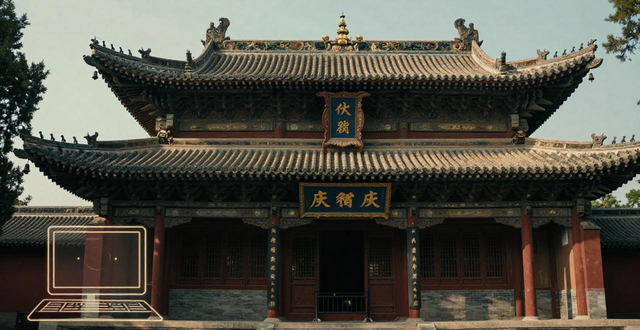
Those four words hung there, so heavy that they seemed to crush people to death. It is said that the world's first electronic computer was engraved with the Bagua diagram drawn by Fuxi. Leibniz said that he was inspired by his binary system. I don’t know if this is true or not, but it’s quite interesting to think about it. The most rustic person turned out to be the most fashionable ancestor.
Sixty-four cypress trees, the password of living
The most spiritual thing in the temple is not the statue, but the tree.
The trees planted according to the directions of the sixty-four hexagrams were replanted after they died, and then died again after being replanted. Currently, thirty-seven trees remain. Gently touching the cracked tree bark, it feels cold to the touch, but it is warm. There is a tree that has stood like this, watching stage performances for hundreds of years, witnessing sacrificial rituals for hundreds of years, and witnessing the comings and goings of people for hundreds of years.
Some people say that there is a "dragon eye" on the cypress tree in the northeast corner. It has a tumor that looks like a dragon's eye. Those who believed this went to touch it, and it felt shiny when they touched it. This is probably the kind of cuteness that people have. No matter what mysterious and profound hexagrams, they all eventually evolved into a simple wish like "touch it and good luck will come."
I really like the wood carvings in the Tai Chi Hall. The dragons and phoenixes carved out on the window lattice are all curled up like a circle. How much patience and joy the carver must have to make the wood so soft. None of the craftsmen five hundred years ago remember their own names, but their fingerprints are still pressed on the scales of these dragons and phoenixes.
Sacrifice, the living need to talk to the past
The sixteenth day of the first lunar month is said to be Fuxi's birthday.
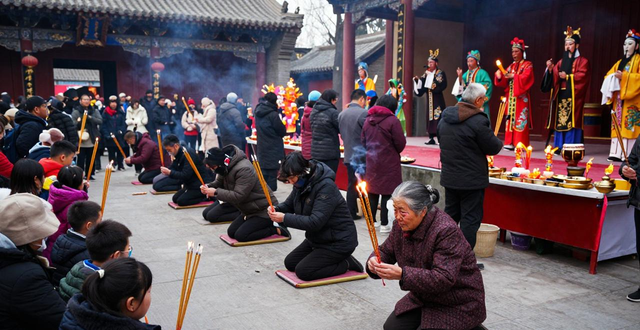
That day, the temple was so crowded that there was no space left. There were people burning incense, people kowtowing, people singing on the stage, and people selling candy. One time I happened to meet and saw an old woman kneeling on a futon, muttering words in a low voice. When she stood up, her eyes were red and bloodshot.
What is she asking for? Fuxi couldn't care about her grandson's college entrance examination, nor could she manage her wife's leg pain. Yet she believed it. What she believed in was not God, but the solid feeling of having someone listen to her.
By June 22, the style of painting had completely changed. A public memorial ceremony was held, sponsored by the government. The memorial ceremony was performed with music and dance, the memorial text was reverently read out, and it was broadcast live to the world. The scene was extremely grand. People dressed in ancient costumes performed ancient rituals, bells and drums rang together, and a group of people in suits stood upright and had serious facial expressions.
Folks and officials each perform sacrifices. One side is in an atmosphere full of human fireworks, and the other side is in a ceremonial atmosphere. Fuxi was among them, and he didn't know which one he preferred. As far as I'm concerned, he loves both. It's always good to have someone thinking about you.
The hexagram that cannot be escaped, the siege that cannot be escaped
There is a garden at the end of the temple, which is not small but has a quiet atmosphere. Those who are tired from playing and wandering sit on the stone benches and let their minds relax. There is a couple taking a selfie. The girl imitates the shape of scissors with her fingers. The background of the scene is an ancient locust tree with a history of 800 years. She said so, speeding up, taking a photo of me and the tree named Longhuai, and then posted it to the circle of friends.
The locust tree is silent. People who existed eight hundred years ago must have been waiting for others under this tree. What they were waiting for was such a smiling face.
It's actually quite confusing.
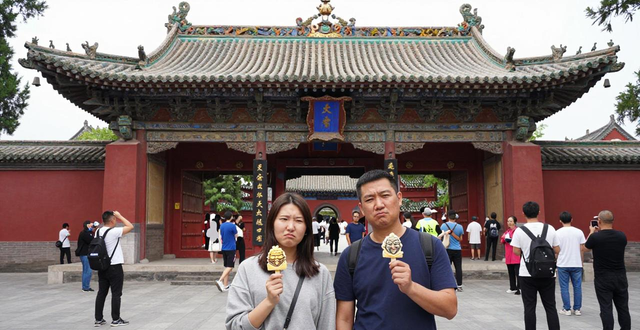
After visiting the temple, we bought a piece of cultural and creative ice cream, complained about the price of the tickets, and then took a taxi to the next stop to eat Malatang. What is the relationship between Fuxi and us? He is still the same symbol from eight thousand years ago, and we are still these anxious bodies in the twenty-first century.
But it seems to be somewhat related.
You will have some thoughts in the following situations: first, when you are under the clay statue; second, when you look at the sky through the gaps in the ancient cypress trees; third, when you witness the trembling back of someone who is kneeling. You will think like this: Oh, it turns out that there is a group of people who, after thousands of years, have always continued to do the same thing - to find a source for themselves and a destination for their souls.
Walk out of the temple gate and look back again.
As the sun sets, the shadow of the cornice is stretched extremely long. It first presses on the cypress trees, and then presses on the windows with hexagrams engraved on them. When the wind blew gently, the shadow swayed, as if nothing had happened.
Eat when you need to eat, drink when you need to drink, stay anxious when you need to feel anxious, but in your heart, you add some unclear confidence. Just like the sixty-four hexagrams, what surrounds you is not necessarily a siege that restricts and troubles people, but may also be a moat with a protective function.
Comments NOTHING