
Sorry to keep you waiting.
1. I’m sick of those “gold-promoting” fake tricks.
To be honest, if you walk on the street and enter any internet celebrity store, you will see “new Chinese style” everywhere.
A plastic blue and white porcelain object was placed on the partition with a pattern of carved dragons and phoenixes. On that wall, there were several oil-paper umbrellas that were difficult to distinguish between genuine and fake.
It is euphemistically called "the fusion of tradition and modernity".
Pull it down.
That is digging out the bones of our ancestors, covering them with a cheap sugar coating, and then throwing them to you without even biting them.
True fusion is so fucking simple.
2. Enlightenment under Dougong Lamp
Until I saw a light.
The bearings, which are made of metal and exude a cold feeling, and belong to the category of industrial supplies, are stacked one after another, and what finally appears is the bracket structure that exists in our ancient buildings.
The light emerges from the metal core, passes through those delicate tenons, and is filtered again by the frosted plate outside.
There was a snap.
It's not the sound of lights turning on, it's the sound of a string in my head being broken.
The shadow cast from the wall is not a rigid and fixed outline. It is dynamic, as if the corner of the eaves is gently lifted up by the light.
At that moment, I suddenly understood that the so-called point of convergence was not the act of searching for similar things, but the situation of finding synesthesia that occurred at that moment in an extreme conflict situation.
3. Breathing in the old house in Lingnan
Later I went to Guangzhou and went into a 700-year-old ancient village, Langtou Village.
There is a modern art museum, which is pure white and has very sharp edges and corners. It stands next to the old blue brick house from the Ming and Qing Dynasties.
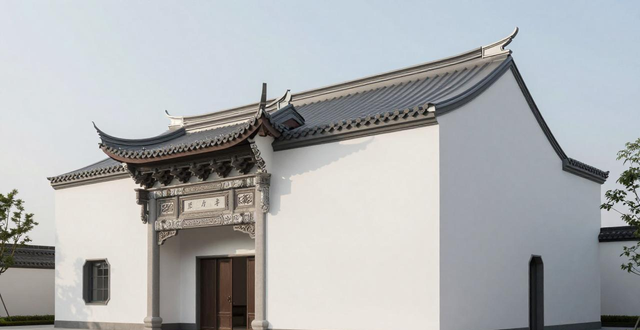
If it were an unskilled designer, he would definitely paint the white house with a layer of antique paint and then cover it with glazed tiles.
But others don’t.
The old house is still an old house, with mottled walls and overgrown weeds.
A white house is still a white house, the lines are so hard that you can cut your fingers.
As you walk towards the village, the wind blows from the old ancestral hall. When the wind passes through the corner of the white wall, it actually carries the aroma of turpentine and coffee.
Children in the village play calligraphy on the interactive display screen in the art center, and tourists carry cultural and creative fish lanterns through the ancient alleys.
This is not a visual patchwork, this is the flow of breath and the survival of tradition. It is not something that is lifted up and enshrined, but something that can breathe.
4. Can you sing Song lyrics with acrylic?
Another set of furniture comes to mind.
Transparent, red and blue acrylic chairs.
Ridiculous, right?
However, when you take a closer look at the lines of the legs and feet, you will see that they are the form of wishful cloud patterns stripped from Song Dynasty paintings, and their smoothness is just like the dancing toes.
Acrylic is originally an industrial, cold, and even a bit frivolous material.
But it's transparent.
The transparent moiré pattern dispels the heaviness of tradition.
The light passes through the chair, reflecting dark shadows of various colors on the ground, like neon light, like the disappearing scenery of the four seasons.
Isn’t this what the ancients said: “the virtual and the real complement each other”?
It’s just that the ancients used white space, but we use transparency.
5. What exactly does it mean to “understand” tradition?
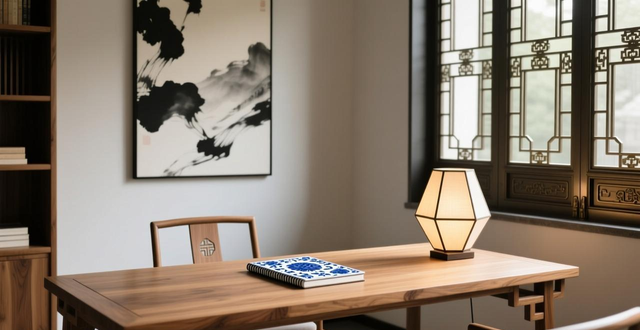
Many people ask me, what does it mean to understand tradition?
It’s not that I can recite the Analects of Confucius, or that I can recognize a few seal characters.
You have to understand that this is why people in the Tang Dynasty loved the complicated curves of the gate, which is a layered presentation of the self-confidence bred in the prosperous age; why people in the Song Dynasty were obsessed with minimalist monochrome, it was the loneliness revealed by the literati turning to their own hearts to explore.
You need to peel away the patterns, then the structures, and then the colors, layer by layer, just like peeling an onion, to find the breath hidden underneath.
That tone was called aesthetics, called philosophy, and how people of that era viewed the world and themselves.
You look up again and look at the current materials.
Metal, glass, acrylic, even protective green mesh on construction sites.
If you know it, you will find that cold metal can simulate the warm texture of wood, and transparent glass can capture the mist of ink.
You have to let them fight and have a good fight, don't rush to make peace.
6. In the digital age, where are the pins?
The steps are even greater now.
Someone used AI to break down Dunhuang's flying ribbons into geometric lines and printed them on sneakers.
Someone made Fengxiang New Year pictures into AR, scanned them, and the doorkeeper sang Qin opera on his mobile phone.
There are even some people who use the construction site green network to create a huge "caisson", with a constantly rotating animation on the top, interpreting the concept of the unity of nature and man.
This is no longer fusion, but a chemical reaction .
Digital technology is not a patch, but a new needle and thread. It can sew those scattered ancient stories into our lives again and bring them back.
However, the stitches must be thin and dense. They cannot just sew the surface of the skin, but must penetrate the bone marrow.
7. What is hidden in the corner is the sincerity
I still like those inconspicuous corners.
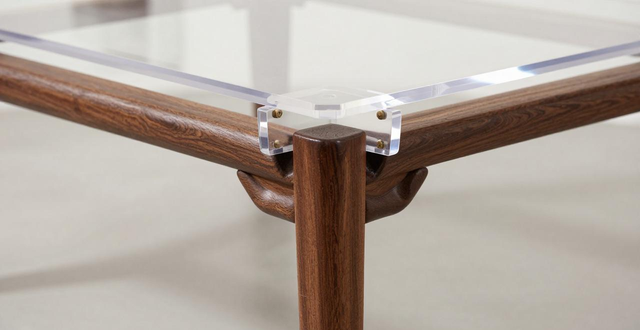
There is a set of things called an acrylic coffee table. What touches my heart the most is not the dazzlingly bright table top, but the part where the table legs are connected to each other, that is, the small section of "horseshoe" with an antique style.
Just a few centimeters of curve, hidden underneath.
If you don't squat down, you can't see it at all.
The designer just made it, and it was extremely sophisticated.
This kind of "hidden elegance" is the real elegance.
It’s not to please anyone, it’s just that designers and ancient people clinked wine glasses across thousands of years of time and space.
8. Why do we still need “old”?
At the end of writing, I want to say something that touches my heart.
That kind of integration is what we pursue, not to decorate the appearance, nor to brag at the wine table.
It's because modern life is so fast that it makes people panic.
Those glass curtain walls, steel and concrete, and digital torrent have left us breathless.
At this time, you come home and touch a chair.
The chairs are made of transparent modern materials, but the curves are the breeze of the literati of the Song Dynasty and the auspicious cloud of the noble ladies of the Tang Dynasty.
You suddenly became quiet.
You know, time is not a river that cannot go back, it can turn back and overlap.
What we need is not to preserve tradition, nor to tear it down and use it as firewood.
It is to drink it, turn it into blood, and then turn it into a force in the bones, and then grow it again with the help of today's materials.
Even if it looks crooked, even if it only has a tile or a lamp.
As long as the tone is still there, the soul is still there.
Comments NOTHING