
To be honest, I stared at the computer screen for a long time.
At this time, who doesn’t have something with a so-called “new Chinese style” in their home? Taobao is full of items with fake mortise-and-tenon structure carved by machines. In the model room, there are hanging items called “Suzhou embroidery” wholesale from Yiwu. After seeing too many of these things, your eyes will feel tired.
What really shocked me was when I was in my friend's extremely messy rental house last month.
In a space the size of a palm, there was a solitary jar made of rough pottery with a chipped mouth in the corner, with a dry and lifeless dog's tail grass inserted in it. Later, he told him that it was the last creation that his grandma made by drawing blanks according to her own ideas. It did not achieve the good effect required for firing, and cracks and gaps appeared.
At that moment, I felt that the broken jar was ten thousand times more advanced than any Nordic style vase.
Stop pretending, what we want is not "cultural symbols"
When many designers mention traditional crafts, they seem to have obsessive-compulsive disorder.
His mind instantly sketched out the appearance of blue and white porcelain, red lanterns, happiness, wealth and longevity. There is a huge wooden moon hanging behind the sofa, and I am so eager to carve the words "I feel so relieved" on it.
Come on, that's decoration, not life.
Those leaky windows in the Suzhou Museum are really beautiful, but they are works by I.M. Pei and they are public buildings. If ordinary people like us, in a small space of tens of square meters, cram a stone sculpture on the level of the Imperial Ancestral Temple, wouldn't it feel eerie and scary?
Really good integration requires restraint.
That kind of thing, when you look at it, there is nothing unusual about it, but when you reach out your hand and put it on, the heat transmitted from your fingertips suddenly makes you stunned.
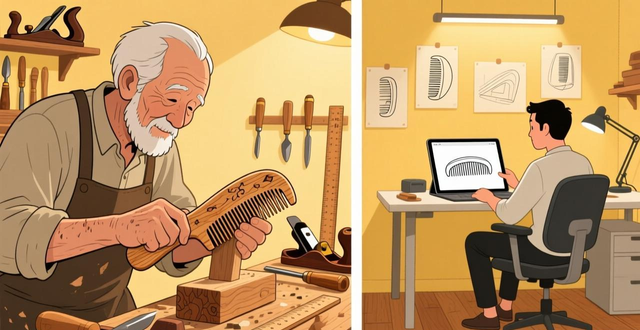
The "imperfection" of handwork is the antidote to the coldness
We are deceived by those "extremely smooth" industrial products.
The edges of IKEA tables are all 90-degree right angles, precise and cool. However, have you ever seen a black walnut side table that is hand-polished little by little? It is curved and grows according to the characteristics of wood.
There is also the ladder wood stacked carving, made by He Xinyu.
The wood is cut into thin slices with a thickness of 0.3 millimeters, then carved layer by layer, and then stacked on top of each other. There is a flower whose petals have real layers. When sunlight shines on it, its shadow is reflected on the wall, showing a three-dimensional shape. Such a texture can be imitated by 3D printing, but the subtle trembling marks left by a manual carving knife cannot be imitated.
There is also the "no matter" lacquer art studio in Fuzhou.
Lacquer, which has been used for thousands of years, is laid on the floor and embedded in the interior decoration of the car. Each floor has a different pattern because the lacquer can breathe and change in the air. Lying on such a floor in a daze, what you feel is not the coldness of industrial products, but a warm feeling similar to some kind of living object.
Color Revolution: Who says tradition has to be “plain”?
We have all been lied to.
When it comes to tradition, it is ink painting, black, white and gray. It's as if our ancestors never wore patterned clothes.
Look at those Yun brocades from the Ming Dynasty. They were the clothes worn by the queen. They were woven with gold threads. The colors were bright red and green, making them look domineering and revealing. However, in the past, who would have dared to bring these colors into their home? Because these colors are so vibrant.
Now designers dare.
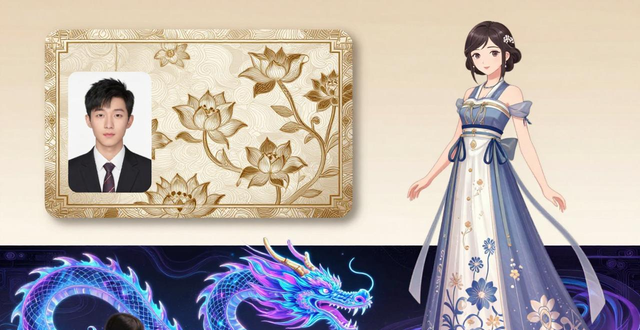
The Yunjin company in Nanjing innovated by printing traditional patterns on top of citizen cards and co-branded with a game called "Miracle Nuannuan". A student used AI to draw a cyberpunk-style dragon. At first, veteran artists thought it was nonsense, but half a year later it became an industry benchmark.
Even more amazing is the bamboo furniture.
Designer Xu Mingyu dyed bamboo into bright yellow, sapphire-like blue and precious sapphire blue, crimson-purple purple, and then used the "herringbone weaving" method and the "hexagonal weaving" structure to make coffee tables and chandeliers.
Can you believe it? There is a bamboo woven lamp with a bright red and purple color hanging in that place. During the day, the sunlight penetrates through it and casts colorful shadows on the wall. At night, when the lamp is lit, the color is not the gleaming light of paint, but is transmitted from the fibers of the bamboo, giving it a warm and explosive feeling.
Traditional crafts suddenly become very "cyber" and "Memphis".
Functional defection: from "furnishings" back to "things"
The biggest mistake we made before was to offer traditional handicrafts.
Screens used for shielding can only be viewed but not leaned on. Embroidery-made items should be framed but not touched. Isn't this a problem?
What were traditional crafts originally used for? Hold water, serve rice, block wind, and keep warm.
That four-star hotel in Zhumadian did something really cool.
"Yu's crochet", known as an intangible cultural heritage, has been directly used in the hotel lobby and guest rooms. Huge crocheted sunflowers are placed in the hotel lobby, and small crocheted vases are placed next to the pillows in the guest rooms.
When you stay in the hotel, you can touch those delicate stitches at your fingertips, and you can also hold a large soft object as a "flower" to take photos and post them to your circle of friends. The inheritor of crochet is Yu Shuiyun, whose words are extremely precise: "Intangible cultural heritage should not just be specimens placed for people to watch, but should become participants integrated into life."
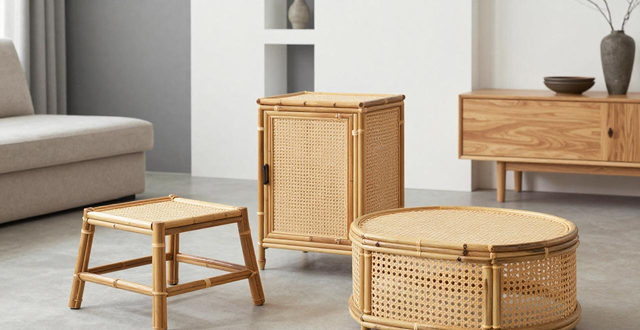
And the bamboo woven furniture, it’s not just for looking at, it’s really something you can sit on and put things on.
The home of the future: should be like a “container”
After talking so much, I deeply feel that the intervention of traditional crafts into modern design is actually to explore a so-called "human touch" with human emotional atmosphere and characteristics.
AI has the ability to draw 10,000 perfect renderings, but it cannot draw the nagging words hidden in the stitches of my grandmother's shoes when she was putting them on.
The machine can carve out the absolutely rounded table legs, but it cannot carve out the trace of blood left on the wood after a young man scratched his hand with a plane when he first learned carpentry.
So, if you are renovating or want to add something to your home.
Don’t go to one of those “high-end craft gift shops.”
Go to the country market to buy a clay bowl with a hole in it and grow more meat.
Go to a special area where craftsmen engage in specific hand-made activities, and buy a hand-made chair that makes a special sound when people sit on it, but is unwilling to throw it away.
Even buy yourself a bamboo knitting material bag and clumsily weave a crooked basket to hold dirty clothes.
The things at home must have some traces of "humanity".
That’s what we can’t buy with money, a living tradition.
Comments NOTHING