
Twenty years ago, when the word craftsman was mentioned, people would always think of wood chips and the smell of old paste. At that time, if a child went to learn basket weaving or blacksmithing, although relatives and neighbors would not say it openly, most of them would sigh secretly in their hearts and think: Hey, this is a useless person. I am afraid I will have to rely on this to make a living in the future. However, who could have predicted that the word "craftsman" would soon become an extremely sexy traffic password in short videos, and would become a standard feature of the "new Chinese style" life that young people are competing to check in.
This transformation is both magical and real.
It’s not just about living, it’s the “way of living” that has changed
In the past, when we talked about traditional handicrafts, what we talked about was livelihood, rice bowls, and masters leading apprentices. What we worried about was that this craft would be cut off from inheritance and future generations would have difficulty making a living. Now when we talk about it again, the context has completely changed. The country has been protecting cultural heritage for more than 20 years. The Level 4 Intangible Cultural Heritage List contains hundreds of thousands of items and has thousands of national inheritors. This not only gives legal status to the craftsmanship, but also seems to inject a refreshing dose of medicine into our cultural memory.
To put it bluntly, relying solely on policies and subsidies can continue the existence of related things, but it cannot continue to operate for a long time. What really makes these old things come back to life is the change that is brought about entirely by ourselves.
### Who is buying? Those "post-00s" and "post-90s"
According to data, on e-commerce platforms, the groups that support half of the intangible cultural heritage consumption are actually the "post-00s" and "post-90s". This situation is indeed quite interesting. At first, I thought that the people who bought these items would be nostalgic middle-aged and elderly people, but then I found that I was wrong.
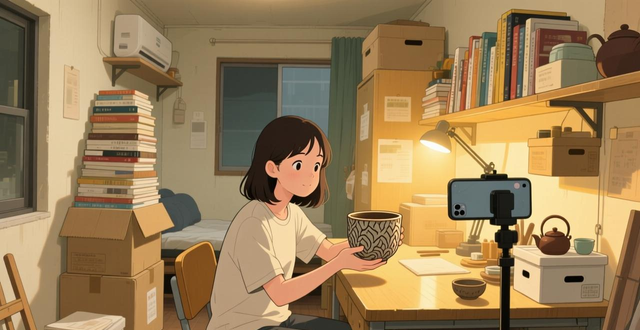
I met a young woman who had just graduated. She rented a house with an area of ten square meters, but she was waiting for a wood-fired cup worth several hundred yuan in the live broadcast room. Ask her what exactly it is for? She claimed that there is a difference in feel and each line is unique. When you hold it in your hand, you feel that such days are not like those cold repetitions on the assembly line.
You see, this is not the act of buying anything. It is clearly a confrontation that points to the sameness of the industrial age and the sense of nothingness that accompanies being swallowed up by big machines.
### When rattan weaving meets parameterization, when AI embroiders "Long Forest and Fengcao"
If you want to survive in your craft, you have to "act like a monster" and change.
Did you know that in Chengdu, someone is currently using AI to produce Sichuan brocade, integrating the artistic conception contained in the Seven Sages of the Bamboo Forest and the elements of the zodiac horse into it? First, the base is woven by a machine, and then the embroiderers do the finishing touches by hand. The final work is called "Breakthrough". In Hanzhong, people engaged in rattan weaving not only weave baskets, but also launched a joint cooperation with Adidas, using parametric design software to recalculate the patterns, and then produce lamps that can be displayed as works of art.
Originally, Guizhou Miao village embroiderers only picked up needlework when dressing up for festivals. Now their embroidery patterns have appeared on the catwalk of fashion week, mixed with fragrant cloud gauze and silver jewelry, and also sang Miaoling's mother butterfly into the neon lights of the metropolis.
This is no longer just a simple copying behavior, nor is the craftsmanship rigidly pasted on the bag just as a logo. This is a translation method with mutual transformation. Designers transform craftsmanship into presentations of aspects of life that modern people can understand. Craftsmen use the needles and threads in their hands to transform the restless state of modern society into a slower rhythm stitch by stitch, calming it down.
### Stop pretending, what you bought is not an object, but a personal IP
It needs to be admitted that sometimes consumption is quite vain. According to the survey, more than 30% of people believe that handicrafts are a symbol of "quality life". Buy a handmade leather product and post it on your friends circle with the words "craftsman spirit", and you will instantly feel that your taste has been sublimated. There is nothing wrong with this.
At least, this is better than showing off a famous brand logo, right?
The bamboo bag you bought may contain a day's leisure time of a lady in a mountainous area; behind the buckle brooch you wear is a "family heirloom" carefully guarded by a post-90s maker in the city. When consumption evolves into a tribute to a different lifestyle, this kind of transaction is not just a transaction.
What I fear most is that craftsmanship becomes “landscape”
But there are concerns. Some crafts have become too "fast" in order to cater to the market.
If you want to catch people's attention in a 15-second video, only the most splendid close-ups will be left, and the boring and wasting basic skills will be cut out. There are some so-called "innovation" situations where popular sayings are pasted on old objects, but they all look nondescript.
One day, I am particularly afraid that intangible cultural heritage will become just a "background for internet celebrity check-ins". People will come in droves, take photos, post promotions, and admire it, and then immediately turn around and leave. No one will really calm down to learn and touch it. The technology has disappeared and disappeared in the traffic.
Let it return to daily life, even if it is just a lamp in the corner
To be honest, revival is not that mysterious. In fact, it is about transforming bamboo weaving into a breathing lamp by your bedside. At the same time, it is about transforming tie-dye into a comfortable scarf that you can wear casually in the summer. It is also about making the tea brewed from the water boiled in the silver pot contain a hint of mountain and wild flavor.
Young people are beginning to accept "imperfection".
Take away the extremely minor imperfections left by handwork, take away the slight asymmetry in the shape of the vessel, and take away the fact that the color is not absolutely uniform. By accepting it this way, it is a gentle rejection of the standards of perfection set by industry.
The revival of craftsmanship is the revival of people.
Those who support themselves and gain dignity through craftsmanship are the craftsmen who stick to the old craftsmanship; among the people who will return to the village and use new media to tell the world about their ancestors, there are young people with ideas; those who are willing to pay for the slow and slow stitches in the fast pace are you and me in front of the screen.
Policies set the stage, but whether the opera is performed well or not depends on whether the audience applauds.
Not bad, the applause became louder and louder. It is not that craftsmanship is pitiful and therefore needs to be protected. Rather, in those hand-made works with warmth, we meet ourselves—the self who does not want to be formatted and is full of desire for uniqueness and is full of vitality.
Comments NOTHING