
Have you noticed the Hui people next to you wearing white hats or veils of various colors? Please note that I used to find them mysterious and even a little alienated. However, when you really get close to them, you will find that the mysterious feeling will evolve into a kind of, how should I describe it, like a touch at the apex of the heart.
Today I am not going to mention those official, cold introductions, but I want to talk to you about a vivid and lively Hui people who are full of real emotions.
Where did they come from? A story about "mixed race"
Many people ask me, are all the Hui people from Arabia? Actually not.
If you think about it, during the Tang Dynasty, among the jingling camel bells coming from the Silk Road, not only silk and porcelain arrived, but also waves of Central Asians and Persians. After they arrived, they never left, married a local girl, and then gave birth to children. By the time of the Yuan Dynasty, the Mongolian army went on a western expedition and brought a large number of Muslims into the Central Plains.
Well, the Hui people are actually a nation with mixed race characteristics. What flows in its veins is both the romantic feeling from a foreign land and the simplicity from the Loess Plateau. And this kind of "mixed blood" situation at the genetic level itself contains some contradictions and poetry.
Little white hat and hijab: they are not clothes, they are the faith written on the head
Why do men wear white hats?
What the Hui people call a "prayer hat" is an inconspicuous little white hat. It is not meant to have a good-looking visual effect, but to allow the forehead to gently touch the ground when kowtowing. In its heart, it only has thoughts about Allah. This type of hat comes in a variety of colors, such as white, black, and gray. The thicker styles are worn in winter and the lighter styles are worn in summer.
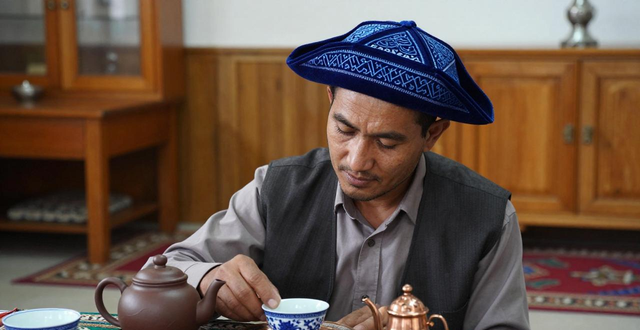
Perhaps you have seen such a hexagonal hat, which belongs to the Jekhrenye sect. The six corners symbolize the six creeds. They are in a state of silence, but the hat seems to be verbalizing.
A woman’s hijab hides the secret of her age
This is quite interesting. By looking at the color of a Hui woman’s hijab, you can guess the approximate period of her life.
The green ones are girls, like spring leaves, fresh and fresh.
The dark one is the married daughter-in-law, calm as if late at night.
The white ones are old people who have grandchildren, washed away and look like snow.
They cover their hair and their ears. This is not done for "feudal" reasons, but because in their belief, the beauty displayed should only be reserved for the closest people to see.
The invisible embroidered shoes
The Hui people have a rather special kind of shoes, which are called "worship shoes". In addition to these names, they are also called "shoes and socks". You need to take off your shoes when entering the main hall to worship, but your feet cannot be bare. So there was this kind of cloth sock shoes with soft soles and high-rise styles.
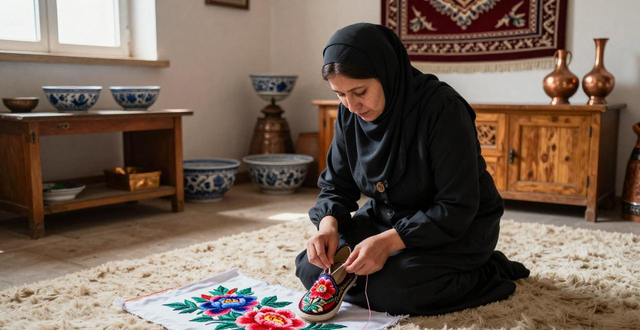
Where is the most moving part? It's on the soles of the shoes. Since the face is pressed against the ground when kneeling, only the soles of the shoes can be seen. Therefore, those Hui women will embroider the most beautiful peonies and plum blossoms in their hearts on the soles of their shoes stitch by stitch - they are presented to God for viewing, and they are also for their own enjoyment.
Have you ever had the feeling that a person's truest heart is hidden in the most unnoticed place?
There are also embroidered shoes worn by women in the mountains, and tiger-headed shoes worn by children. The toes of the shoes are embroidered with tigers, which are said to be easy to feed and have strong vitality. In fact, all mothers in the world have the same heart.
About "paying attention" and "not paying attention" to eating
When talking about the Hui people, everyone’s first reaction is: they don’t eat pork.
Well, that's right, but it's not entirely correct. They do not eat pork, nor do they eat animals that have died by themselves, nor do they eat blood. However, cattle, sheep, and camels are for food, and they must be slaughtered after reciting the name of God. What is behind this is not discrimination, but in fact a persistent idea of "cleanliness".
Interestingly, there are differences in the way Hui people eat in different places. Ningxia Hui people may drink milk tea and eat ramen in the morning, while Gansu Hui people eat highland barley as their staple food.
Every New Year, it becomes more and more interesting. The Hui people living in Beijing do not eat dumplings on the first day of the Lunar New Year, but eat braised noodles. They will not eat dumplings until the second day of the Lunar New Year - "I just want to miss you by one day." Such a small persistence is really endearing.
Those unspeakable pains and prides
It was quite difficult for the Hui people in history.
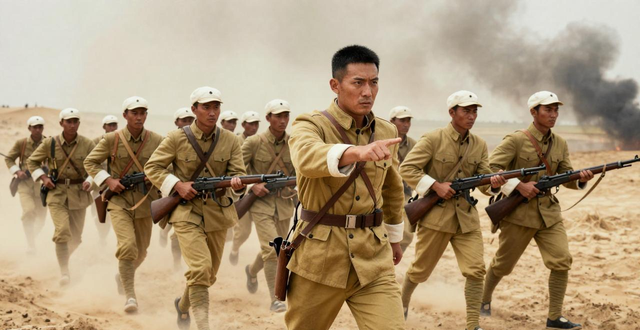
During the Anti-Japanese War, there was a team that could make enemies fearful when they heard its name. It was called the "Hui People's Detachment" and the person who led this team was Ma Benzhai. All members of this team are Hui men. They wear white hats and rush to the battlefield, shedding blood in the plains of central Hebei.
Going back further, there is Guo Longzhen. As a Hui woman, she accompanied Zhou Enlai, Deng Yingchao and others to join the revolution and devote herself to the women's movement. She was later arrested and faced the enemy's butcher knife, but she never uttered a sound.
So, you see, in the bones of this nation, there is the softness when praying, and at the same time, the hardness when facing life and death.
Written at the end: If you have Hui people around you
If there are Hui friends around you, don't always stare at the hats they wear, and don't always ask curiously, "Do you eat pork?"
Go try their steamed buns, they are crispy and fragrant.
Go and have a drink. The tureen tea he made for you might be filled with red dates, longan and rock sugar. It was a sweet taste that he poured out his heart to give you.
The Hui people are not far away from us. They exist in the heat of the noodle shop in the alley there, in the distant chanting from the mosque in the early morning, and in the hearts of every ordinary person who is busy with life.
They are the same as us, but there are differences. It is precisely this so-called difference that has become the most charming place in this world.
Comments NOTHING