
I don’t know when it started. As long as the issue of managing congestion is mentioned, three words will pop out of the mouths of those experts: "congestion charging."
It seems that after collecting money, the road will be smooth. Professor Lu Huapu said that this has just begun, and all provincial capital cities will fall into congestion in the next three to five years. I choose to believe it. But why does collecting money feel so uncomfortable?
London’s sky-high bills, our cure?
I just conducted a search and found that by 2026, London's congestion charge has risen to 18 pounds a day. This 18 pounds is about more than 160 RMB when converted. Even if the tram passes, you will have to pay 13.5 pounds. Calculated after a week, those office workers have to spend 90 pounds just to enter the city center. This 90 pounds is about 820 yuan when converted. Darling, how can this situation be regarded as relieving congestion? It is clearly putting a noose around the necks of people who drive to work.
The London Underground is as dense as a spider web, but what about us? In second-tier cities, squeezing buses during morning and evening rush hours depends on luck. The public transportation system has not yet been built, but you are asking for money first. Isn't this the same as "you haven't learned to walk on your own, but you want to run to collect tickets"?
Who cares about that little money?
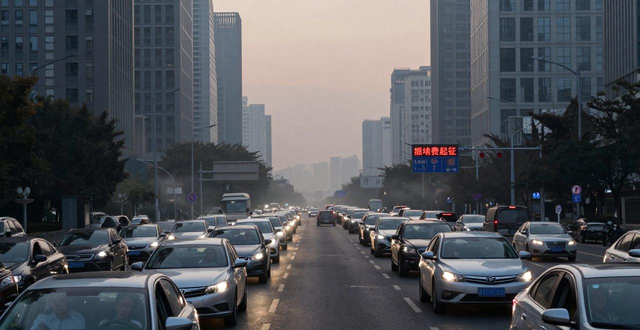
After all, the congestion charge will always screen out ordinary people .
Do those big bosses who really drive luxury cars care about those ten or twenty yuan? What people pursue is time and comfort. Bus? Not to mention, the car modification plan back then was clearly written, and bureau-level cadres received a monthly subsidy of 1,300 yuan. This amount of money is enough to pay the congestion charge for several days. It is a financial expense anyway, just like meat rotten in a pot, there is nothing to feel bad about.
Which bystander will bear the bitter taste in the end? He is the ordinary working-class person who has saved up money for several years and just bought a vehicle for daily travel with the intention of picking up his children and taking his parents out for a walk on weekends.
New York is tearing us apart
There is a very interesting thing. On the other side of the ocean, in New York, there is a big drama going on. Trump just took to social media to call the congestion charge a "disaster" and said it "must be ended immediately." Right there, the MTA, the Metropolitan Transportation Authority, hurriedly sent back data saying: traffic volume dropped by 11%, air pollution decreased by 22%, and bridge crossing time accelerated by 50%.
The quarrel was so intense that it was difficult to stop, and even a federal judge was involved in it, questioning the government. The question was, "On what grounds can you renege on a contract after it is signed?"
You see, there are endless battles over this matter all over the world. This is not a purely economic issue. It is about rights, about fairness, and about the development model. It is a complex issue that is difficult to solve.
What is more important than collecting money?
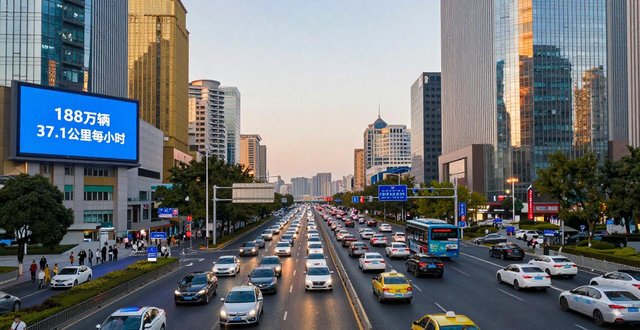
What really convinced me was Nanchang, a city that can be called an “top student”. It does not implement license restriction measures, and the number of motor vehicles has reached 1.88 million. During the peak period, its average speed can actually reach 37.1 kilometers per hour, which is faster than Wuhan and Changsha.
If it’s not about collecting money, how is that achieved? This is achieved through refined management. On snowy days, snow melting agent will be spread in advance. Able to handle accidents quickly. Smart screens and navigation apps will also be used to divert traffic flow.
Beijing has also become smarter this year. It no longer just looks at collecting money, but carries out "scalpel-like" management of 100 intersections prone to congestion, optimizing traffic lights and adjusting lanes. Jinan is more realistic, using big data to find congestion points. As long as people call 12345 to report where there is congestion, they will prioritize those areas.
If I don’t drive, you have to let me find other ways to live.
The premise of charging congestion charges is that you have to give people a decent way to walk .
Look at the buses, they are as crowded as sardine cans, the subway cannot reach your doorstep, and the shared bicycles are parked in such a mess. At this time, you actually said to me, "Stop driving and pay the money." Isn't this clearly bullying people, forcing them to have no choice but to do extreme things? How is it any different from forcing people to jump over a wall?
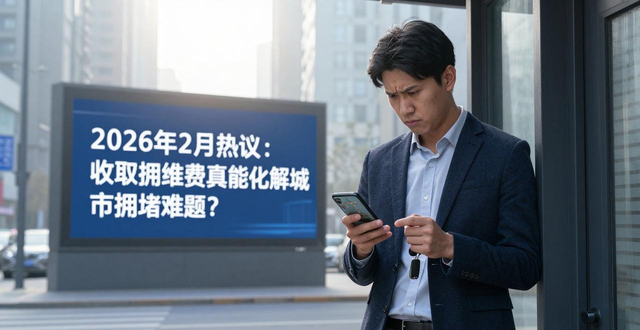
To truly achieve the effect of relieving congestion, it is necessary to make the person hesitate when preparing to go out, whether to choose to drive or take the subway. Taking the subway is quite fast and the ride experience is quite comfortable, and the body will not feel tired. After thinking about it, he decides to take the subway.
When most people take the initiative to take the bus, the roads naturally flow smoothly, and they are not forced to travel by bus due to congestion charges. However, at this time, they are still holding back their breath.
write at the end
Don’t blindly believe in congestion charging. It is not a magical medicine that can solve all problems. Instead, it is more like a shot of analgesic medicine that only temporarily stops the pain. However, the root cause of the problem is still there, that is, the city’s various functions are overly concentrated in one place, public transportation is not convenient enough, and the separation of work places and residences is very serious.
Professor Lu said there are three lines of defense. On the contrary, I think that collecting money should be the last step, and should only be implemented when there is really no other way. Before that, we need to make buses more comfortable, build bike lanes more coherent, and reduce the number of buses to an appropriate level.
This enables people who do not have the ability to drive to live a decent life. At that time, everyone actually had their own standards for measuring congestion.
Comments NOTHING