
70% of the clothes hangers come from the same place? Who would believe this if told?
But I went to look it up, and it turned out to be true. Lipu, Guangxi, is a small town. You may not even be able to pronounce the name of this town accurately.
The clothes hangers in my house may come from a place called Lipu.
On the occasion of the change of seasons, I started to tidy up the wardrobe, holding a handful of wooden clothes hangers in my hands. I suddenly recalled that number, that is, 70% of domestic clothes hangers are produced in Lipu City, Guangxi.
Seventy percent. What is this concept? When you open a door at random, there will be seven out of ten items of hanging clothes, and the hangers of these clothes are all related to this small city.
Lipu. In the past, I only knew about taro, but now it is better, and clothes hangers are also famous.
It's quite magical when you think about it. We use it every day, but we have never thought about where it comes from, who makes it, and how it is made. Things like coat hangers are so ordinary that we don't even look at it again.
Thirty years ago, where did the clothes hanger industry come from?
In the beginning, it was actually a small workshop in a mountainous area. In the year 1989, a man named Qin Yuxiang received an order involving foreign trade. The content of the order was-100,000 hangers.
Even professional equipment did not exist there. Planes and hammers were used for manual polishing, and the steel wires from the bicycle wheel hubs were disassembled and used as hanger hooks. So we started working with local methods and gritted our teeth and persisted for half a year.
Six months, as many as 100,000. It doesn't sound like a big deal now, but that was more than thirty years ago, in a ravine where even the roads were not very accessible.
Currently, there are more than 300 clothes hanger home furnishing companies in Lipu, with an annual output value of more than 8 billion, of which 80% of the products are exported. It is the world's largest wooden clothes hanger production and export base.
From 100,000 to more than 4 billion. This number is a bit scary.
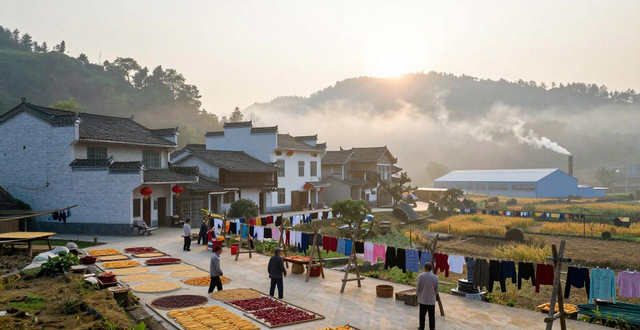
How do you spend a day in Yonghua Village?
Yonghua Village, Qingshan Town. In the workshop of Yuxiang Home Furnishing, the machines are humming.
Liu Guisheng said that it can now produce 200,000 clothes hangers a day. before? Only 200,000 a year.
The automatically running assembly line first performs forming operations, then spray painting, then hangs items on hooks, processes round rods, then performs strapping activities, and finally completes the packing task. The entire process is consistent and uninterrupted. In the past, more than a hundred people were needed to complete the work, but now twenty or thirty people are enough.
When the reporter went to take pictures, in the packaging workshop, there were boxes of wooden-colored hangers, neatly stacked, with English labels on them, such as Asia Pacific and Europe. And it says IKEA.
Yuxiang is a supplier of IKEA. So does Huahai.
Li Xia, the administrative manager of Huahai, said that they started to transform from just making clothes hangers to kitchen utensils for home use in 2016. The reason is that if they just make clothes hangers, there are not many differences.
Quite interesting. A company that makes clothes hangers started thinking about pots and pans.
Why do you have to work outside your home?
Mo Xianzhen has worked at Yuxiang for seven years. She works six days a week and takes one day off. She works eight hours a day and earns a monthly salary of about four to five thousand yuan.
She said that the salary was not bad and she would be provided with five insurances. Close to home, can take care of the elderly and children.
I have heard this message many times, in many places, at the gates of many factories, and from the mouths of people who are working. However, every time I hear it, I still feel a touch and a slight vibration in my heart.
Zhong Canxiong, secretary of the Yonghua Village Party Committee, said that large-scale enterprises in the village have provided employment opportunities for more than 600 people. Because they can work at home and take care of children, there are basically no left-behind women and children in the village.
There are no women or children left behind. This sentence is probably more important than any number of production value figures.
In the village, there is a processing point, which is the wood processing factory owned by Mo Qiuping. It specializes in processing wooden strips for clothes hanger companies. The manufacturer gives a sample, and then they make production according to this sample.
More than one hundred categories. Just make wooden strips, not finished products.
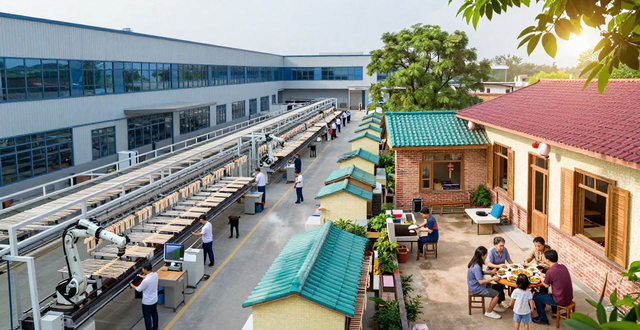
That kind of industrial chain is spread out layer by layer in this way. Among them, large enterprises lead small processing sites, while small processing sites maintain the lives of households.
What else can be done with clothes hangers?
There are more than 3,000 varieties, including wooden, bamboo, fabric, dip-plastic, aluminum alloy, flocking, rubber-plastic, and wood-plastic.
They have every material you can think of. They also have things you wouldn’t expect.
Moreover, 8 of the national industry standards for clothes hangers were drafted and formulated by Lipu. Bamboo hangers, fabric hangers, solid wood hangers, etc., these sound like quite official standards, but they are made by a county enterprise.
Liao Kehong, who serves as the director of the Lipu City Industry and Information Technology Bureau, claims that the single product of wooden clothes hangers has reached the first place in the country and the world.
Next step? The industrial chain needs to be extended longer and longer. The export market is doing well, but there are still shortcomings in the domestic market.
With more than 30,000 industrial workers, more labor force must be released to develop other industries.
those invisible hands
The Lipu Clothes Hanger Home Furnishing Industry Association, established in 2009, now has 41 party organizations with 193 party members.
In order to achieve the goal of moving from "Made in Lipu" to "Made in Lipu Intelligently", the association plays a leading role, cooperates with universities, and is committed to cultivating relevant talents, including going to Xiamen University for training and establishing an industry-university-research docking relationship with Chengdu University of Technology.
Along with the follow-up process of science and technology finance, Rural Commercial Bank has created a model of "clothes hanger and home furnishing industry theme bank", and has completed a loan operation with a total amount of 620 million. In addition, it also involves related matters such as science and technology innovation funds, green approval channels, and special loans for specialized and new enterprises.
Yuxiang Home Furnishings alone has accumulated nearly 400 million in credit.
The manpower is in place, the funds have been allocated, and the relevant technologies are in place. In this way, matters related to clothes hangers were started.
The face behind the hanger
Qin Yuangao, known as the president of the Lipu Clothes Hanger and Home Furnishing Industry Association, whose father was the one who took the first order that year.
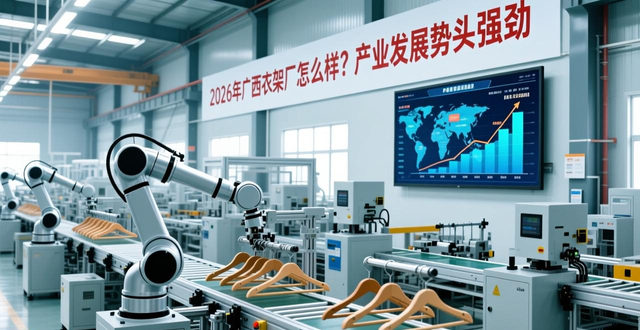
It is said that in the future, we will have to transform from "manufacturing" to "intelligent manufacturing", and we will have to work with universities to cultivate talents, and then expand our share of the global market.
The last sentence is quite touching: making "Lipu Clothes Hanger" a brand-new business card for the world to recognize China.
A new business card. Start with a clothes hanger.
If you think about it carefully, many times the "Made in China" we refer to is not the big things that look shiny and great in people's minds. On the contrary, it is these small items that seem inconspicuous at first glance, such as hangers, buttons, zippers, lighters, etc. They quietly do not attract much attention, but they are actually filling every corner of every home in the world.
Come home in the evening and hang up the fresh laundry.
The clothes hanger squeaked.
I suddenly wondered, could this sound be heard over there in Lipu?
After writing it, I found that it was just over 1,000 words. just.
The clothes hanger is really too small. It's so small that we never think it has anything to say.
However, it is precisely these small items that enable more than 30,000 people to make a living, build an industry system worth 8 billion, and are distributed in countless wardrobes around the world.
So next time you pick up a clothes hanger, give it a second look.
It probably comes from Lipu, Guangxi.
There are mountains and water in that place, there are people who made clothes hangers by hand thirty years ago, there is Mo Xianzhen who is now sitting in the automated workshop, and there is also Mo Qiuping who sticks to planing wood strips at the processing point every day.
They just hang quietly in your home.
Hang clothes and some inexplicable things.
Comments NOTHING