
In fact, I am quite afraid of writing this kind of lesson plan.
I am afraid of writing content that is as cold as an instruction manual, and I am afraid that stereotypes such as "guiding young children through activities" will limit the children who are originally lively and full of vitality to the established process. At the same time, I am also afraid that parents will become more anxious after reading it, and will feel that sending their children to kindergarten is like sending their children to an assembly line.
There are two "wild" kindergartens in Henan. I have looked through many kindergarten activity records in the past few days and I was shocked by them. Instead of memorizing ancient poems and doing handicrafts, the children gathered around the stove and learned how to cook roast chicken, and even ran wildly on the single-plank bridge. There should be a sparkle in the child's eyes. Isn't that what a child should look like?
Are more "wild" babies better to take care of?
Today's children are too "clean" and cannot touch the soil with their hands. Whenever their feet are about to tread water, as long as they run a little faster, adults will quickly shout "be careful of falling" behind them!
In Jiaozhou, a kindergarten accomplished something “beyond the norm.” This kindergarten arranged for teachers to blindfold themselves and participate in the "Blind Warrior" activity. In the first round, the person acting as a protector carried out supporting movements throughout the process and continuously issued reminders such as "be careful". The teacher said that at that time, he was so nervous that he even lost the courage to lift his feet. In the second round, the protector took three steps back and only provided help when necessary. The teacher said, "Although he was invisible, he knew someone was not too far away, so he dared to take steps."
Only then did the teacher understand that excessive protection is not love, but a rope.
The small anti-slip mushroom stickers allowed them to attach them to the balance beam, and walking on the balance beam became a game of "picking mushrooms". The teacher who was two meters away stepped back and said with a smile: "I'm right here. If you need help, just call me."
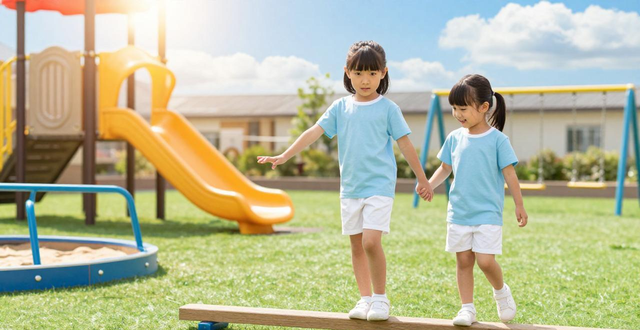
After letting go, a miracle happened. The extremely shy Duoduo dared to open her arms on the single-plank bridge to maintain balance. The girl named Xiaomi not only walked on the balance beam by herself, but also walked with her friends who were afraid to walk.
Games, what exactly are you "playing"?
Parents often ask: If you play every day and don’t learn to read and count, what will you do when you go to primary school in the future?
A kindergarten director made an analogy. Children are like saplings. Don't rush to see how tall they can grow. Instead, you must first make the roots deep. Play is taking root. During play, children learn to focus, learn to find ways to learn, and learn to cooperate with their friends. These are the "deep roots" that support children's lifelong learning.
In Huilongshan Kindergarten in Changxing County, a game called "Little Frog Jumps on Lotus Leaf" was launched. This game uses hula hoops as lotus leaves and allows children to pretend to be little frogs and jump across. On the surface, it looks like a random jump without any rules. However, if If you know the reason or not, do you know that this seemingly simple jumping action actually has the effect of exercising the strength of the child's lower limbs, training the child's body coordination, and cultivating the child's imitation ability.
The child is "pretending", but his body is "really growing".
The kindergarten in Shimen County, Hunan is even more amazing. Children in the top class use homemade "banknotes" to buy items in the "Rainbow Supermarket". Then, I took ten yuan and went to the community supermarket for shopping. There was a child who found that the bread was expired. He solemnly declared that he could not buy it and recorded it in his notebook with graffiti. You see, financial intelligence, social interaction, and food safety awareness are all solved in the game.
What I fear the most is this kind of homework
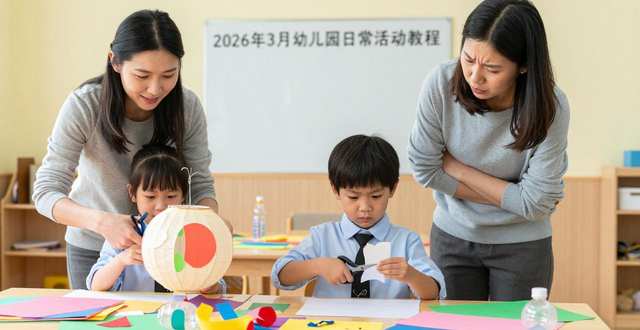
Some parents complained to me that their children were required to make lanterns out of scrap materials in kindergarten. However, the children could not even hold scissors steadily. As a result, their parents were busy all night.
Is this parent-child homework or a parent skills competition?
A good teacher is one who knows how to "step back". In Shuangliu District, Chengdu, a kindergarten is playing with rolling hoops. When the child first started pushing, the hoops moved everywhere. The teacher didn't teach me "this is how I should push", he just watched. So what's the result? One child discovered that if he slowed down and followed with small steps, the hoop could roll three meters away. Another child tried to push two hoops with both hands and use the hoops as hula hoops.
The abilities that a child develops on his own are a hundred times more vivid than those that are taught.
Adults who don’t dare to play, and children who don’t know how to play
The biggest problem may not be that children don’t know how to play, but that adults don’t dare to let their children play.
There is such data, and the survey is really heart-breaking: more than 60% of parents are afraid that their children will be bumped and injured, so they are unwilling to let their children run in the garden; more than 70% of parents have basically implemented a ban on activities that have the attribute of "safety hazard".
When adults pave the road too smoothly, children lose the opportunity to learn to walk on their own.
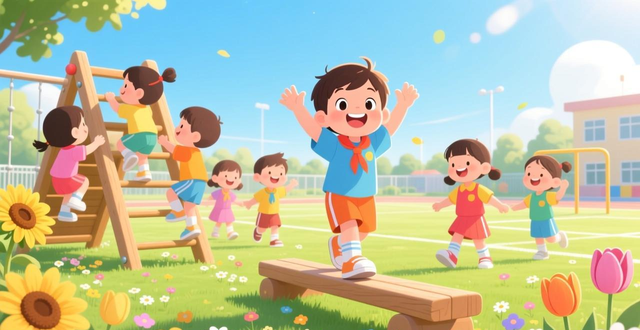
As for whether the remarks made by the principal are reasonable, in fact they are: only allowing children to take "moderate risks" can truly benefit them. When a child's eyes become bright because of a successful challenge, the self-confidence that grows from deep within is the confidence that can support their future.
write at the end
I am getting off topic as I write. I was originally going to write lesson plans, but ended up writing a lot of them.
Forget it, no more modifications.
I just want to express that perhaps the most outstanding lesson plan does not exist on paper, but is reflected in the sweat beads of children when they run wildly, in the focused side faces of children when they squeeze mud, and in the shining eyes of children after successfully jumping over a puddle.
Let the kids play. Get up when you fall down, wash yourself off when you get dirty.
Those "wilder" days are what childhood should be like.
Comments NOTHING