
I don’t know why, but when Jilin folk customs are mentioned, everyone seems to be talking about black ginseng, ginseng, and deer antlers.
It seems that in this black land, there is nothing else but these "treasures" that can be sold for money.
It's really frustrating.
Why is the window paper stuck outside?
I saw the old photo exhibition held in Jilin City a few days ago, and I was immediately struck by it.
In those black and white photos, the eyes of the people are different from the current situation. Not like a tourist, with a curious mentality, nor like a performer, showing a business-like smile.
It is a kind of determination that has lived in the ice and snow for several lifetimes.
It may be hard for you to believe, but when I was a child, I actually saw this situation of "raising children and hanging them up". I didn't understand it at the time. I thought it was too cruel to be a parent in that way. Later I learned that the ancestors of the Manchu people used hunting as a means of livelihood and hung their children in trees to avoid wild beasts. Later, they settled down and hung their children under the beams in order to exercise their balance ability so that they could better ride horses and fight in the future.
What kind of survival wisdom is this?
The current early childhood education classes and sensory integration training cost thousands of dollars per class. However, hundreds of years ago, only a bicycle solved the related problems.
Korean grandma’s kimchi philosophy
Last October, Jilin City held a kimchi festival, and I went to join in the fun.
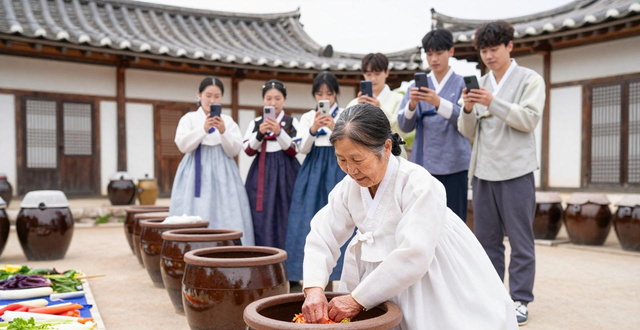
There was an elderly Korean woman wearing a plain white Korean dress, squatting there and working on pickling kimchi. Her movements were so slow that it made people feel anxious. She was surrounded by a circle of young people, filming with cellphones in their hands, but she didn't even raise her head.
Someone asked her: "Grandma, do you have any secret to making kimchi?"
She raised her head, took a look, and then said something very simple: "There is no secret, but you need to choose firm cabbage, spread the salt evenly, keep your hands steady, and your heart should be in a quiet state."
I suddenly recalled the ancient houses in Bailong Village in the Yanbian area. Those houses did not have a single iron nail and relied entirely on mortise and tenon joints to interlock with each other. They are still standing there after more than a hundred years.
There is no secret.
Just keep your hands steady and your mind calm.
Chagansari, the Mongolian New Year
The Spring Festival is early this year, celebrating the New Year in early February.
Did you know that the Mongolian people call the Spring Festival "Chagansa Day", which is also the White Festival, which is the name of the festival. It starts from the fire sacrifice on the 23rd day of the twelfth lunar month and continues to be lively until the second day of February.
Among the Mongolians in Qiangarros, there is a custom in the early morning of the first day of the Lunar New Year that men need to walk a few hundred meters away from their homes to perform a ritual of offering sacrifices to the sky in an auspicious direction. Then return home, extend New Year's greetings to the elders in the family, present Hada, and perform kneeling rituals.
These rituals are hidden in specific actions. It’s not a performance, it’s a legacy.
Speaking part, drum music, those inaudible sounds
Not long ago, the "Intangible Cultural Heritage Celebrating the New Year" event was held in Jilin City, in which the Manchu Speaking Troupe, Shishi Drum Music, and Northeastern Drum performed in turn.
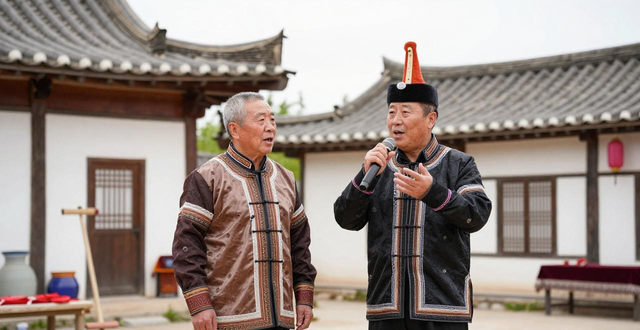
I stood under the stage and looked at the old man in the singing club.
In fact, I couldn't understand any of what he was singing. It was Manchu, with an ancient melody, just like the wind blowing through the pine forest, and like the cracking of the glacier.
But I don’t know why, my eyes are a little hot.
The old man next to me said to me: "If this thing is not passed down, it will really disappear."
No more, what does that mean?
It’s not that an art form dies, it’s that a way of looking at the world dies.
Taming a falcon is a kind of trust
There is also a set of photos of falconry in the old photo exhibition.
Located in Yingtun, Tuchengzi, Jilin, the people who first lived there raised eagles not for fun, but to survive. The eagles will assist you in hunting activities, and you have to give the eagles a certain amount of food.
This is not conquest, but transaction, and companionship.
The old man in the picture has an eagle on his arm, and his eyes are as sharp as an eagle. It is not clear whether the eagle resembles him, or whether he resembles the eagle.
Northeast Kang, the center of the family
Having said so much, what actually pricks me the most is how people in Jilin live their lives.
The big kang placed in the traditional houses in the Northeast is the core of the Northeastern family. In winter, even when the outside temperature reaches minus 30 degrees, the temperature on the kang is so high that it can burn your buttocks. The whole family will crowded together on the kang, eating sunflower seeds here, chatting about homely things, and watching TV at the same time.
That kind of warmth cannot be given by a heater.
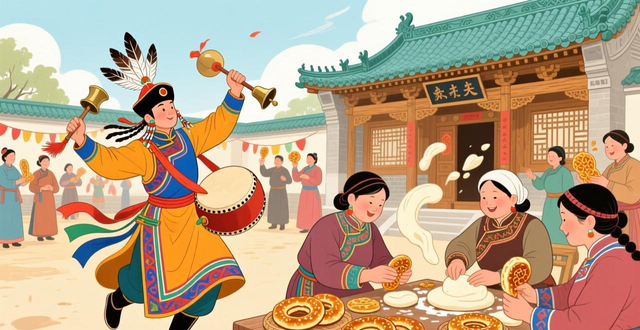
Not only are there dumplings for the New Year's Eve dinner, they are stuffed with cabbage and pork, which means "hundreds of wealth", and the whole family makes them together. Some people knead the dough vigorously, some carefully roll out the dough, and some carefully stuff the stuffing. Even the children who are naughty and mischievous, even if they make a bunch of weird-looking and weird-shaped things, they still cook them in the pot and still eat them with gusto.
write to the end
I don’t know why I am writing this today.
Maybe I just feel that those old things shouldn’t just be gone.
Wuling ginseng is valuable, ginseng is valuable, and deer antlers are valuable.
But some things cannot be sold by the pound. It’s like the heat in the palms of an old woman’s hands while she’s making kimchi, like the gaze of a falconer looking at the sky, or the laughter of the whole family huddled on the same kang on New Year’s Eve.
These things are the real foundation of Jilin folk customs.
If I don’t say it anymore, it would be pretentious to say it again.
Go and have a look at Chagan Sari, listen to Manchu speaking, and find an old Korean woman to ask for a piece of kimchi to taste.
While these things are still there.
While you still remember.
Comments NOTHING