
Sometimes I think stones can breathe.
Especially at five o'clock in the morning, Angkor Wat is still immersed in the dark night. You step onto the collapsed stone steps and walk toward the inside. The light from the flashlight passes over the reliefs of the Apsara fairies. Their lips, their breasts, and their fingertips are all cold. However, when you stop and stand in front of the lotus pond, waiting for the eastern sky to change from indigo to fish belly white, and then suddenly burn to golden red, and the five corn shoot-like spiers slowly appear from the reflection in the water - you will hear the stone take a breath.
It's alive.
This place is called "Little Angkor" by Cambodians, and it is painted on the national emblem, but I feel that it does not belong to any country, but only to time.
Suryavarman II’s big gamble
It’s crazy to think about it.
In the 12th century, there was a king named Suryavarman II who killed his uncle and seized the throne. Probably because he felt guilty and needed to do something important to shock everyone. So he declared: Build me a temple.
This is no ordinary temple.
Hope reaches its greatest extent, and expectations present an appearance closest to heaven. My wish is for everyone in the universe to know that God Vishnu and this me live in this place.
For more than thirty years, stones from all over the country have been transported here. Those stones are sandstone taken from the Kulum Mountains. Each piece weighs several tons. During transportation, they relied on ivory, rafts, and tens of thousands of hands. They crossed the Tonle Sap Lake and were finally dragged into this rainforest. There is no cement or nails here. The stones are stacked on top of each other, and even a blade cannot fit into the gaps.
What do you think they are trying to do?
I speculate that the king never saw the day when it was completed. When he passed away, Angkor Wat might still be installing the spire, but he ignored it. What he pursued was what happened after his death.
This is a mausoleum. It faces the west, towards the direction of sunset, and the people buried there face the direction of sunset. In Hinduism, there refers to the place where the dead return. There are reliefs in the gallery, and all the reliefs are carved counterclockwise. That is the path taken by the funeral procession. He hopes that after his death, he can become Vishnu and live in the center of Mount Meru forever.
How arrogant. How naive.
Those fairies who can't talk
The corridors of Angkor Wat are too long.
Walking more than 2,000 meters, there are eight giant reliefs. When you enter from the west corridor, you will be greeted by a battlefield-like scene depicting the battle scenes in the "Mahabharata". In the picture, elephants trample over infantry, bowstrings are cut deeply into people's necks, and dead soldiers are piled up in layers like thousands of mountains. The sounds of fighting in the Battle of Kulu seemed to have been frozen and frozen by stones for a thousand years.
But I don't like those.
I have a fondness for the east wing of the North Corridor, where there is a row of Apsara nymphs, more than three thousand in number, and each one is different. Some of them are smiling, and some seem to be in a daze. There is a fairy's gesture called "horse head posture", which is said to be the most popular dance posture in the court at that time. When the craftsman was carving her, who was he thinking about?
There may be such a real girl here. On a specific afternoon, she passed by the craftsman, with calico wrapped around her waist and bells on her wrists. The craftsman remembered her appearance in his heart, carved her into stone, and carved her into eternity.
That girl is long dead. The bones turned to ashes.
But her hands were still dancing on the wall.
The forest swallowed them back
1431.
The Siamese invaded. The Khmer abandoned Angkor and fled to Phnom Penh.
More than four hundred years. No incense, no worship, no cleaning.
The banyan tree species began to take root in the cracks in the rocks. The roots of the strangler fig are like pythons, tightly strangling the pillars in circles. Birds left seeds on the top of the tower, and the saplings grew into big trees, piercing the top of the tower. Vines covered the fairy's face.
The whole city was eaten back by the forest bite by bite.
Sometimes I am quite envious. When a civilization disappears, it does not mean that it disappears. It just falls into a deep sleep, surrounded by tree roots, watered by rain, and occupied by monkeys.
If our cities built of cement would collapse and be destroyed if no one existed, they would collapse within fifty years. But this is not the case. Those solid objects made of stones have the characteristics of long-lasting waiting.
Zhou Daguan has been here and seen it
During the Yuan Dynasty, Zhou Daguan, a native of Wenzhou, took a ten-month sea voyage to come here to carry out business trips.
He stayed in the land of Chenla for a whole year, and then returned and wrote a book called "Chenla Customs", in which he only described Angkor Wat in one sentence, namely: "The Tomb of Luban".
How funny.
Luban. A Chinese carpenter became the "author" of Khmer temples.
However, other things recorded by Zhou Daguan are of interest. He said that at that time, there were people living in the city, there were market transactions, and there was also a saying like "Wealthy Zhenla". It is also mentioned that there is a bridge plated with gold and stone inside the temple, which is more than forty feet long, and its gorgeousness is very shocking.
That was 1296.
After 135 years, the place is empty.
If it weren't for the book written by Zhou Daguan, the 19th-century Frenchman Mouhot would not have set foot in this forest, nor would he have "rediscovered" Angkor Wat.
Mouhot recorded in his diary: "The magnificence of the temples in this place far exceeds all the achievements left to us by ancient Greece and Rome. When you walk out of the gloomy Angkor temple and return to the world, at that moment it seems that you have suddenly fallen from a glorious civilization to a wilderness."
He said it as if he had discovered it.
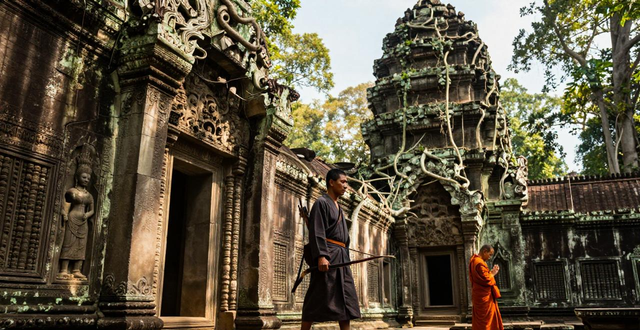
In fact, hunters and monks in Cambodia have never forgotten this place. They have always carried out hunting activities here and performed pilgrimages here. However, no one has asked them.
Digging out your own belongings from the rubble
This is quite infuriating.
In April 2025, a cultural relics expert from China stated at a press conference that they unearthed porcelain from the Song Dynasty at the ruins of the Angkor Wat palace.
From the Song Dynasty.
It is more than a hundred years earlier than Zhou Daguan.
It's not mentioned in the literature at all. But there is it underground.
The ship set out from Quanzhou or Guangzhou, crossed the South China Sea, and arrived at Chenla. The merchants unloaded the bowls, jars, and jars in exchange for pepper, ivory, and rhinoceros horns. Then these porcelains entered the palace, were used by the Khmers, were broken into pieces by the Khmers, and buried in the ground, waiting for us to dig them out.
Civilized exchanges are never just about fighting.
And bowls.
How to go, how to see
(I can’t help but want to say something real, although travel notes shouldn’t be like guides.)
If you plan to go, remember to buy a three-day ticket, which costs $62 and requires fingerprint entry. Do not buy scalper tickets.
For accommodation, choose Siem Reap. Get up at 4:30 in the morning and arrive at the Lotus Pond before 5:00 to grab the front seat. The sunrise is around 6:00, so you won’t suffer any loss if you go as early as possible.
Clothes that go past the knees and have sleeves. It’s not rigidity, it’s respect.
If possible, find a tour guide. Or take a look at Jiang Xun's "The Beauty of Angkor" in advance. Otherwise, what you are facing is a pile of stones, and you don't know which one is the churning of the sea of milk, which one is the battle of the monkey king, and which one is the French official's wife who fell to her death from the stairs. After she encountered an accident, the handrail was built.
If you have enough energy, go climb the "ladder of love". Its steepness will make you question life. You need to use both hands and feet, and you have to climb backwards when going down.
The temple says that this is for you to experience "the hardship of ascending to heaven."
I don’t know what heaven is like.
However, when you climb up, sit on the threshold of the West Tower, and watch the sun sink into the rain forest, causing the entire Angkor Wat to be dyed dark gold, at that time, you will believe it.
Khmer smile
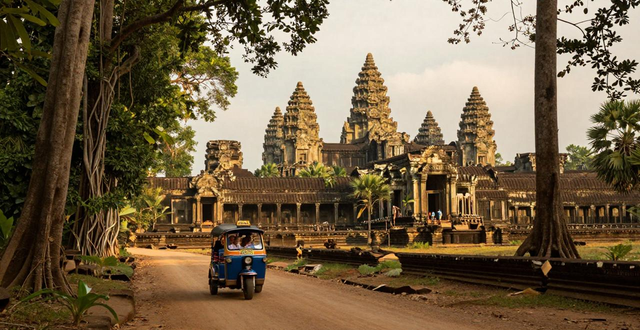
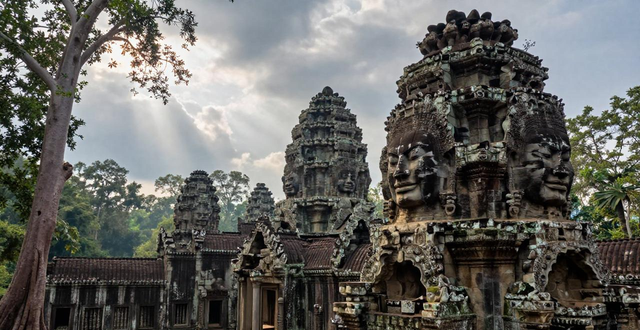
From Angkor Wat to Bayon Temple, it takes twenty minutes by tuk-tuk.
There are 54 pagodas there, each with four sides, and each side shows a face, a total of 216 faces. All of these faces have their eyes closed and the corners of their mouths are slightly raised.
It’s called “Khmer Smile”.
Some people say that he has the appearance of Jayavarman VII. That monarch once participated in wars, built roads, and established hospitals! Finally, he carved himself into the shape of a Buddha statue and placed it in every corner of the city.
You can't hide at all. No matter where you go, as long as you raise your head, he will be there. Even if you close your eyes, he will smile at you.
That smile. How to say it. No mercy, no ridicule, no welcome, no farewell.
It's right there.
Have you seen Zhou Dakan? You should have seen it. He didn't write it. Maybe he felt unable to write.
I sat in Bayon Temple for a long time that day. An old lady from Japan sat next to me and looked at that face. She suddenly said a Japanese sentence that I couldn't understand at all, but her eyes turned red.
There are some things that language just doesn’t deserve.
Goodbye, stone
It’s been more than a month since I returned from Angkor.
Sometimes when I turn off the lights and lie down at night, those stones will still come to my mind.
Spire. cloister. Fairy fingers. The roots of the strangulating fig.
They are still there, in the rainforest, exposed to the sun, torrential rain, touched by tourists, and scanned by archaeological teams.
They say nothing.
But once you've been there, you know that there are things in this world that are bigger than you, older than you, and slightly closer to eternity than anything eternal you can imagine.
Once you have been there, you carry a stone with you in your heart. Heavy.
But you know that's good.
That's called seeing the world.
Comments NOTHING