
I couldn’t figure out which moment it was, but when I saw this news, my heart suddenly skipped a beat. Is it necessary to study the entire content of the "Tao Te Ching" in high school? And you want to compare Confucius and Socrates together? Looking back at that time, I was still scratching my head and scratching my head anxiously over reciting Tongjia characters.
It's actually quite wonderful, but also quite dangerous.
Is our generation “culture mixed with raw food”?
To be honest, it is quite embarrassing for our generation to be parents born in the 1980s and in the early 1990s. When I was a child, I was forced to recite "Zhi Hu Zhe Ye". If I couldn't memorize it, I would be slapped on the hand. The hatred in my heart at that time was really deep. After you grow up and enter the society, the "Chinese Studies craze" has arisen again. If you don't have some understanding of "governing by doing nothing", you will be embarrassed to discuss projects with others.
But if you actually ask me to explain the difference between "benevolence" and "goodness", I will most likely be confused.
It seemed like everything was stained and nothing was chewed up.
When Confucius meets Socrates, should we fight or have a drink?
According to the news, it is necessary to conduct a comparative analysis between Confucius’ “benevolence” and Socrates’ “goodness”. This kind of question is quite difficult to be honest.
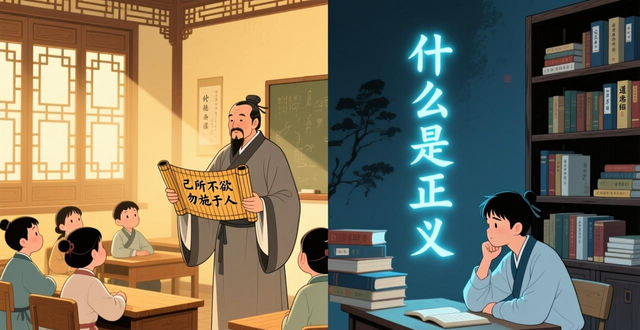
One is to convey to you "Don't do to others what you don't want others to do to you", elaborating on the warm line between people. The other follows you and asks "what is justice", and has to dig out those vague things in your mind to see the sunshine.
In the past, when we studied Chinese, it was Chinese, and history was history. They were separate.
But now this textbook wants to bring East and West to the same table.
I am worried that after my children finish learning, not only do they not understand it, but they become even more confused. Who should they really follow? This is really a tangled question!
Can being cautious and studying things to achieve knowledge be eaten?
The book is also divided into chapters such as "Being cautious about independence", "Regulating the family", and "Studying things to gain knowledge".
It sounds mysterious at first.
But as a father like me, my first reaction is: Is this the college entrance examination?
After reviewing the information, I discovered that the research team was indeed conducting research on a new question type, and the name of the new question type was "Political Theory" or "Apply Theory."
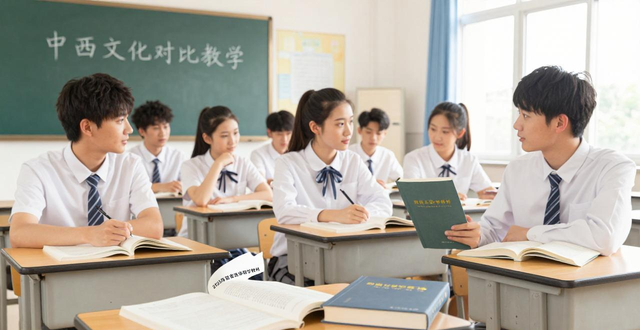
It does not require you to engage in dictation, but it requires you to write a small essay on the topic of "cultivating oneself, regulating one's family, governing the country, and bringing peace to the world."
Then it becomes interesting. Compared with the so-called standard answers, it encourages children to think and explore on their own. Even if mistakes are made during the thinking and exploration, this is far better than rote memorization.
It's like you have fallen in love before you understand what "doing things you don't want others to do" means.
Don't teach this kid to be an "old master"
There is a popular term on the Internet right now called "cultural confidence."
But I am uniquely afraid that this word has turned into a slogan that only shouts but does not do anything. I am even more afraid that this textbook will teach these high school students to be that small type that cannot be moved by any reason, similar to a "fighter" existence.
Confidence is not about thinking that you are the best in the world behind closed doors.
Real self-confidence is when after hearing Socrates' questioning, he turned around and took a look at our Confucius. He still felt that he had a solid foundation in his heart, and even felt that Confucius was warmer.
This is the meaning of "comparison". It is not to compare whether you win or lose, but to look in the mirror.
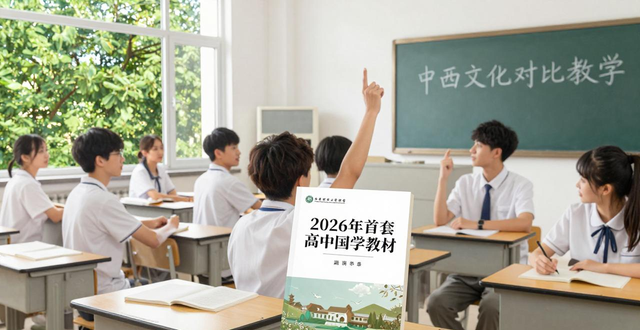
As for the exam... I'm sorry, kids.
In the end I couldn't help but laugh.
The concept of this textbook is good, allowing children to "investigate things to gain knowledge" and think independently.
However, when it comes to the final exam, it is very likely that the content of "Which of the following belongs to Mencius' view of justice and benefit" will be tested.
The ideal is very full, the reality is very skinny.
But no matter what, these children who enter the classroom in the fall are happier than we were back then.
What we learned at that time was knowledge, but what they learned was a hair of wisdom.
Even if it is just a hair, it is enough to prick them in this impetuous society and make them wake up for a while.
Comments NOTHING