
Occasionally, I wonder if this area of Taizhou has all the past events of China secretly hidden in the alleys.
It's not the kind that's put on display for you with a grand momentum, but it's hidden in the gaps between the blue bricks and the black tiles, and hidden in the rings of the old locust tree. You need to get closer and put your ears close to hear the squeaking sounds.
Let’s talk about Guangxiao Temple first.
I didn't go there early in the morning, but chose an evening near closing time. There were very few people at that time, and the wind was extremely strong. The wind blew against the copper bell at the corner of the hall, making a tinkling sound, as if someone was striking a small hammer above the clouds. That temple was built in the Eastern Jin Dynasty. It is more than 1,600 years ago. The footprints of many pilgrims were piled on top of each other, making the threshold a little lower. I stood under the ancient ginkgo tree. I heard that it had been standing here for more than 800 years, and its leaves made a rustling sound. I suddenly thought, how many people's prayers has it heard? How many tears seeped into the soil at its feet? It was silent, just standing upright, and its leaves turned from yellow to green.
Then there is Wanghai Tower.
Can you really see the sea from Wanghai Tower?
No more. The sea water has receded long ago, completely, leaving only one building standing there, like a stubborn old man, guarding an agreement that will never be reached again.
It was built in the second year of Shaoding in the Southern Song Dynasty and is called "Jianghuai First Building". When I climbed up, it was dusk. The water of Fengcheng River was reflected in the golden light by the sunset, and several boats were swaying slowly by. You can't actually see the sea, but you can see the city's rich fireworks atmosphere. Fan Zhongyan, Ouyang Xiu, Yue Fei, Kong Shangren - these figures have all stood on this floor. There must be a difference between what they saw then and what I see now. But there seems to be no difference. They are all the kind of melancholy that tries hard to preserve this moment, but cannot keep it no matter what.
When I went downstairs, my legs felt a little weak.
I ran into Qiao Yuan by mistake.
It was not that I was looking for a convenient place, but as soon as I turned the corner, I saw a garden that dates back to the Wanli period of the Ming Dynasty. After more than 430 years, it is the earliest existing classical garden in northern Jiangsu. To be honest, it is much smaller than those gardens in Suzhou, so small that it is even a little cramped, but it is precisely this crampedness that makes people feel at ease.
The first garden in Huaizuo is actually quite small.
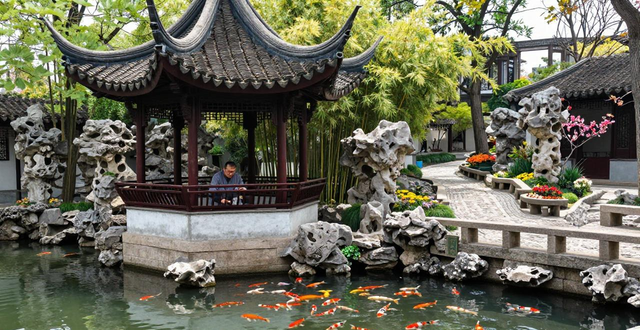
There is a pavilion called "Shuyu Pavilion" in the garden, and its name is really interesting. I sat down at that place and actually counted the fish in the pond. There were red fish, white fish, and colorful fish. They were swimming back and forth in the water, swimming endlessly. I counted them seriously at first, but as I continued to count, it became chaotic. Just like this garden, it doesn't seem to be very large, but once you start walking around, you will lose your way. The rockery made of Taihu stones has winding and winding paths. As long as you turn around slightly, another small world will appear.
It is said that this place used to be the private residence of Qiao Songnian, the salt transport envoy to the Huaihe River. Salt merchant, how rich he is. However, in this garden, there is no such dazzling, luxurious and tacky atmosphere. Instead, it has a simple and old appearance, like a blue cloth gown that has been worn for many years. The color has faded after washing, but it has been washed straight and smooth, revealing an aloof and proud temperament.
Taoyuan.
I originally went to the Mei Lanfang Memorial Hall, but I didn't expect that going to the peach garden would be an accident. I ended up breaking into this peach blossom forest with more than 3,600 peach trees and 116 varieties of peach blossoms. It was not March or April when I went. The peach blossoms had already withered by then, and the trees were full of lush green leaves.
The interesting thing is not the peach blossoms, but Kong Shangren who created "The Peach Blossom Fan". He lived in Chen'an in the garden. His official career was not going well and he was depressed, but he wrote one of the greatest works in the history of Chinese opera. It's really ironic. It is difficult to create a masterpiece when one is proud; only when one is unlucky and downcast, with a suffocating heart that is difficult to exhale, can one create a masterpiece that will last forever.
Above the Qingfeng Pavilion, there is a bronze bell. It is said that it is a sister bell to the bell of Hanshan Temple in Suzhou. This bronze bell can only be struck three times. Ringing it once will clear away the troubles. Ringing it twice will increase wisdom. Ringing it three times will allow Bodhi to sprout. I struck it, and the sound spread out dullly. After the strike, are the worries really eliminated? Not really, but at that moment, it did seem a little lighter.
Mr. Mei Lanfang, are you back?
Mei Lanfang Memorial Hall is located on Fenghuang Pier, surrounded by water on three sides.
In the Meiyuan, there is a seated statue made of white marble. The seated statue shows the following posture: Mr. Mei is wearing a suit, with his legs crossed, looking very relaxed. It is said that the height of this seated statue is 2.6 meters, and the height of its base is 0.67 meters, which is exactly the same as his 67 years of life. Corresponding to each other, it is said that he left Taizhou when he was 14 years old and never came back since then. However, the people of Taizhou did not forget him and built such a huge garden for him. The garden was full of plum blossoms and they waited for him year after year, month and day.
Would he be happy if he could see it? have no idea. Maybe.
Even if you don't know much about opera, when you stand in front of the stage that imitates the ancient style, you can seem to hear the babbling sound penetrating through the years, the affection of the drunken concubine, and the heroic sadness of Farewell My Concubine. When the wind blows from the water, it carries a fishy smell, which is unique to Fengcheng River.
After leaving Meiyuan, walking along the Fengcheng River, we encountered the old street. This old street in Taizhou is not actually old. It was built later, but the lively atmosphere is real. There are blue bricks and black tiles, hanging red lanterns, alleys paved with granite, and teahouses one after another - "Zhezheju", "Pipao Shui", and "Guyuelou". These names all exude a lazy and leisurely atmosphere.
What surprised me the most was the morning tea museum.
There are 15,000 shops serving morning tea, with more than 150 different categories of morning tea. The daily consumption of flour reaches 200,000 kilograms, tea leaves consume 2,000 kilograms, and dried silk consumes 100,000 kilograms. 1.3 million people enjoy morning tea every morning. 1.3 million! What is the population of Taizhou as a whole? I stood in front of those data and was stunned for a long time.
This is the history of living people
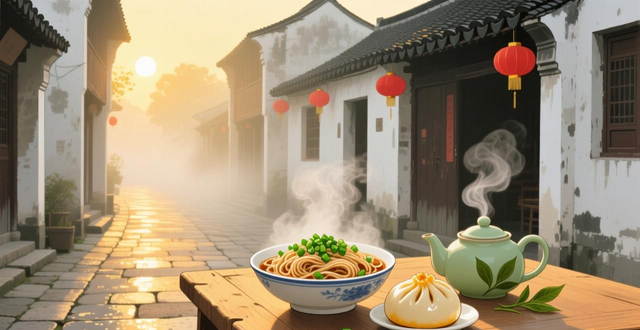
I suddenly realized that Taizhou’s past experiences were not just those old houses, ancient temples, and ancient gardens, but also the steaming bowl of dried shredded silk every morning, the crab roe bun with a wonderful aroma, and the pot of Biluochun with the mellow fragrance of tea. Those things, after hundreds of years, have always existed in this area, passed down from generation to generation, always steaming, carrying the unique taste of chopped green onion and vinegar.
I went to the Navy Birthplace Memorial Hall in a hurry.
White Horse Temple, on April 23, 1949, the Chinese People's Liberation Army Navy was born here. At that time, this place may have been quite peaceful, but who could have imagined that a navy would start from this small town on the riverside.
There are many models in the exhibition hall, such as warships, aircraft and cannons, shining with the luster of metal. However, the thing that made me stand there for a long time was an old photo. There were several young men in coarse military uniforms standing on a small wooden boat with a bright smile on their face. It is the small wooden boat of that shape that keeps rocking and rocking, creating a navy with modern characteristics.
Gotta see those trees.
The largest densely distributed ancient ginkgo area in the country is in the Ancient Ginkgo Forest Park in Xuanbao Town, Taixing. There are thousands of ginkgo trees there. They stand next to each other, just like a group of silent old people gathering together to bask in the sun. I went there. It happened to be autumn, and the trees were full of golden color. When the wind blew, the leaves made a rustling sound, and the leaves fell one after another, falling all over the ground. It felt soft when you stepped on it, as if you were stepping on a layer of golden dream.
There is a ginkgo tree that has lasted for thousands of years. Its trunk is so thick that many people cannot wrap their arms around it. Its bark is cracked, just like the wrinkles on an old man's face, each one telling a story. I leaned against this tree, closed my eyes, and seemed to be able to hear the breathing of the tree, very slow and heavy, one time, and then another.
What surprised me most about Taizhou was the Lizhong Water Forest.
In a place called Qianduo Town in Xinghua, there are trees planted in the 1980s. The place was originally an uninhabited tidal flat. Local people planted more than 100,000 metasequoia and pond fir trees. However, who would have thought that after decades, the place would turn into something like a fairyland.
Isn’t this the real-life version of the Wizard of Oz?
There is water under the forest, and the forest is reflected in the water. Riding on a small wooden raft, the boatman used the bamboo pole to nudge the raft slightly and the raft slid into the forest. Sunlight seeped down from the gaps in the leaves, one after another, like golden strings. The roots under the water can be clearly seen, swaying gently, as if they are talking to the fish in the water. Occasionally, an egret flies by, its wings brushing against the treetops, making a flapping sound.
It is extremely quiet, so quiet that you can hear your own heartbeat. That kind of quiet is not silence with nothing, but full and heavy, as if it is wrapped by a layer of green, moist, and soft things, which makes people feel at ease and want to fall asleep.
The Qinhu Wetland area is much larger. It is a 5A-level scenic spot with more than 800 hectares. Water is the protagonist in it. There are all kinds of water, including lakes, rivers, and swamps. They are connected together and boundless. There are countless small creatures hidden in the reeds, such as wild ducks, egrets, and various water birds that cannot be named. Traveling through it by boat, the waterways are winding and winding. When you turn a corner, you may be a new world.
In autumn, the reed flowers are in bloom, and they are covered in white. When the wind blows, it looks like snow.
The Daohe Ancient Street District, which existed in the late Yuan and early Ming dynasties, has been in existence for more than 600 years. It has the architectural style of Thai-style houses, with an appearance of blue bricks and black tiles. The lanes there are relatively narrow and show a winding shape. Local residents call this situation "entering the five lanes is like eating ecstasy soup." I spent half a day wandering around there, and eventually got really lost. However, I was not in a hurry, and just kept walking, looking at those old houses, the old people sunbathing in the corners, and the pomegranate trees sticking out from the yard.
If you're lost, just get lost. You're not in a hurry anyway.
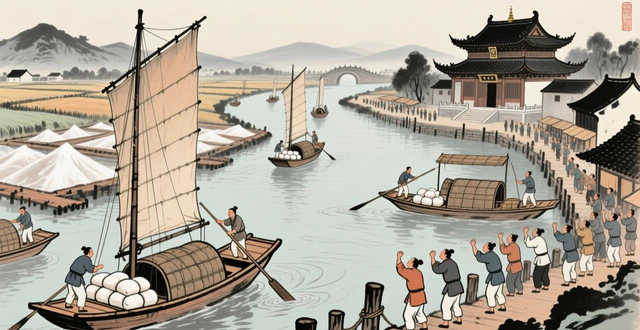
There is a Guanwang Temple, which is dedicated to Yan Zong. Taizhou prospered with salt. During the Western Han Dynasty, King Liu Bi of Wu began to dig a salt transportation river. This river system transported the salt produced in Taizhou to various places. At that time, it was probably an extremely lively scene, with salt boats constantly coming and going, and the chants shouted on the pier were so loud that it shook the sky. Today, the river still exists, but the boat has disappeared, leaving only this small temple and the curling smoke rising from the temple.
On the day we went to Qintong Ancient Town, it happened to rain.
The ancient town is located in Jiangyan. It is surrounded by water and is known as the "Pearl of the Water Town." It is especially quiet in the rain. The stone roads are washed by the rain and shine like mirrors. The dripping water on the eaves makes a ticking sound, as if playing a piece of music that will never be finished. The existence of the town There is an ancient locust tree, which has a history of more than 1,100 years, and a camellia tree, which is more than 800 years old and is known as the "Camellia King of Asia". When I went there, it was not in blooming season, and I could only see a tree full of green leaves. The leaves were shiny and swaying gently in the rain.
The town is not big, so we were able to finish shopping in a short time. However, that wet feeling, that quiet atmosphere, always remains in my heart, just like tea brewed on a rainy day, with a light taste but an unforgettable aftertaste.
Tiande Lake Park, once known as the Garden Expo Park, was only completed in 2009. It is a brand new place, with brand new buildings. Compared with the ancient things that have lasted hundreds of years, it is like a baby still in its infancy. However, this park is quite vast, with abundant water and extremely rich green lawns. On weekends, many local residents come here with their children to fly kites, carry out picnics and enjoy the pleasant time in the sun.
I suddenly thought that maybe in a few hundred years, this park will be turned into a historic site, and people at that time will stand here like me and lament the vicissitudes of history. History is like this, stacking up one layer after another, the old on top of the new, the new becomes the old, and the cycle repeats.
Those under construction, reconstruction, and those not yet completed
The Tianmu Mountain ruins are still in the process of planning and construction, and the People's Park is being renovated. As I pass by, all I can see are fences and scaffolding. However, I know that there is an ancient city hidden inside it that dates back 3,100 years. It is the "first city in the Jianghuai River in the Western Zhou Dynasty". The traces left by the ancestors are being carefully protected, waiting for the moment to see the light of day again.
In fact, Taizhou is like that bowl of morning tea.
Drink slowly and taste carefully to taste the taste. The dried shredded silk has a refreshing feeling, the crab roe buns have a rich flavor, and the Biluochun has a sweet aftertaste. The various flavors are intertwined and do not conflict with each other, but are extremely harmonious.
Such monuments and gardens, the bells of Guangxiao Temple, the evening breeze of Wanghai Tower, the fish in the arbor, the peach blossoms in the peach garden, the drama in the plum garden, the excitement of the old street, the quietness of the ginkgo forest, the dream of the water forest, the openness of Qin Lake - they are crowded together in this small town, and have not hindered each other for hundreds of years and thousands of years. Each has its own posture and temperament.
On the evening of the last day, I went to the Fengcheng River again.
When the sun is about to set, a scene will appear, that is, a layer of golden light is spread out on the river. Several cruise ships were driving slowly forward, and the sound of erhu playing could be heard on the ship, making a babbling sound. It was not clear whether it was the melody of "The Drunken Concubine" or the rhythm of "Farewell My Concubine." There are willow trees with slender and drooping branches growing on the shore. Their branches hang down in the water and sway constantly with the wind.
I stood there and looked at it for a long time.
In fact, I didn’t go anywhere, I went everywhere.
Comments NOTHING