
The street lamp is planted there, exposed to wind and rain, but untouchable by thunder? That's weird.
I am particularly afraid of summer. In the middle of the night, there is a sudden thunder boom, and my heart skips a beat. I have finished thinking, I am afraid that half of the lights on that road will go dark. During the inspection the next day, we were sure to pick up a bunch of burnt power modules, some of which had exploded from the middle of the light poles, leaving dark holes like scars. The property management company was very worried about money, and passers-by despised the darkness, but no one blamed God, and everyone scolded the poor quality of the lights.
However, the quality of this thing cannot be entirely blamed.
A direct lightning strike. Grandpa Lei personally went down to earth, bringing millions or even tens of millions of volts, and struck it directly on the pole. This was not "electricity" at all, it was clearly a bomb. The current drilled into the ground along with the pole, and the ground potential was instantly raised very high, forming a "counterattack". The ground that was originally intended to protect it, in turn, bit the equipment.
Conductive lightning is more concealed. The lightning does not strike you directly, but strikes the wire next to you, or the overhead wire several kilometers away. The surge will be like a pulse, thump, thump, along the cable and conducted to your lamp, and then take away the driving power.
In addition, there are induction mines, and clouds discharge each other, flashing like flashlights. Huge electromagnetic waves rush around in the air, and chaotic voltages are induced in the lines, causing the communication module to appear garbled or directly crash.
Switch overvoltage? That's not thunder, it's better than thunder
Street lights are not always on. They are turned on in the evening and turned off in the early morning every day. For high-power loads, they snap in and snap off. As a result, high-voltage pulses will be generated in the power grid, which are several times the normal voltage. Compared with the destructive power of lightning strikes, they are only less than the brightness of a lightning bolt.
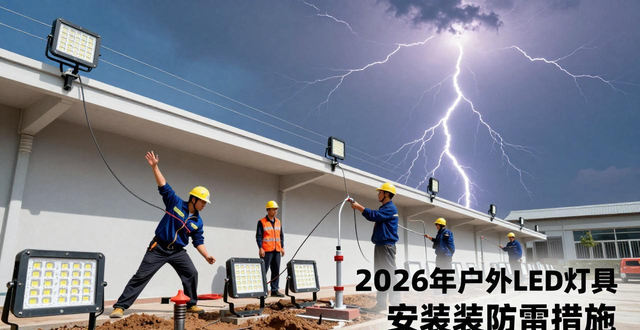
Therefore, don’t think that you can “prevent” thunder. Thunder cannot be guarded against. We must learn to "hide" and "vent".
External lightning protection, take this stab first
Nowadays, most LED street light poles are made of metal, which has its own characteristics that make people feel unbeatable, and it is easy to attract lightning. Then, just let it provoke thunder and lightning.
The air-termination device mounted on the top of the pole is actually an even more annoying needle. Also use thick copper wire as the down wire, lead it all the way underground, and then bury it in the ground network. This is a special highway built specifically for Grandpa Lei, so that he can come down smoothly and walk away smoothly without dangling in the pole.
The ground resistance must be less than 10 ohms. The ideal situation is to push it down to below 4 ohms. If the resistance becomes large, it will be difficult for the line to pass smoothly, and the thunder will become angry and jump around.
Internal lightning protection to block fish that slip through the net
At that time, the lightning current had already leaked away, but as it passed by, a strong electromagnetic field was generated. The surrounding power lines were like antennas, and the signal lines were also like antennas. These two would convert the electromagnetic field into voltage, and then penetrate into the equipment.
Therefore, a surge protector (SPD) must be installed.
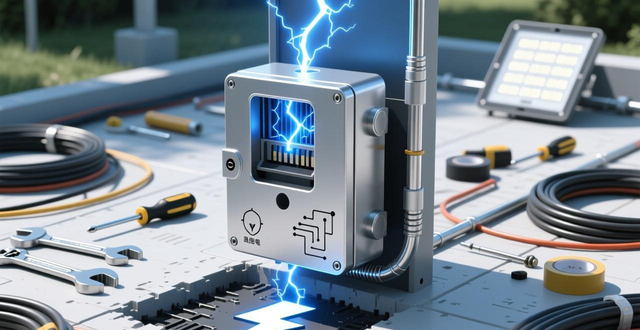
The object is like a smart switch. It is not energized under normal conditions. Once the voltage becomes high, it immediately short-circuits and directs the high voltage to the ground. When the voltage returns to normal, it opens again without disturbing the line operation. It has nanosecond response, which is much faster than human reaction.
The first-level SPD is installed in the distribution box, which is used to withstand large energy, under the light pole and next to the lamp. The second-level SPD is installed again, with the purpose of leaking the residual energy that leaks out of the network again, which forms a double-layer insurance.
Equipotential, eliminate voltage difference
When lightning current flows into the earth, if the grounding of different parts of the equipment is not at the same ground, a huge voltage difference will be formed. This voltage difference is called breakdown.
Therefore, all metal shells, conduits, and cable shields need to be connected to each other by wires, and ultimately connected to the same ground busbar. If everyone holds hands and the potential is at the same height, there will be no current flowing through your body.
Lightning protection module also depends on the standard
The LED power supply itself has to be manufactured.
For constant voltage and constant current output, inspection must be carried out according to the standard of GB19510.13 (IEC61347-2-13).
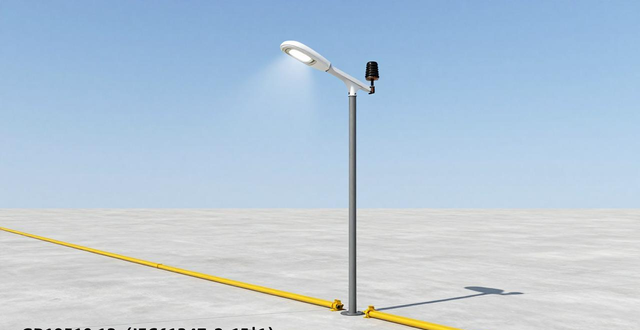
Only engaged in control logic, the work on dimming and color change is carried out in accordance with the standard of GB19510.12 (IEC61347-2-1 to 1).
If it has both functions, it must be strictly inspected according to the more stringent power supply standards.
Just doing an inspection is not enough. Surge impact testing needs to be done. High temperature and high humidity testing is also indispensable.
Just yesterday, I was passing by a road where the lights had just been replaced. There was an old electrician squatting there smoking a cigarette. He pointed at the newly installed lightning protection module and said, "Whether this thing works or not depends on God's mercy and whether he can give me a few thunders to try."
I think the same thing is true. Even if one hundred percent of lightning protection is achieved, it may only be for the accident that occurs in one thousandth of a second.
But I don’t want to go outside.
Comments NOTHING