
It's actually quite strange.
When I heard about ancient water conservancy, the thing that immediately popped into my mind was Dujiangyan. It was built by Li Bing and his son, and its achievements are immeasurable. But what about Lingqu?
It was a project during the Qin Dynasty. Compared with Dujiangyan, it was about twenty years later, but not many people knew about it. Indeed, it is hidden in Xing'an, a small county in Guilin, Guangxi. It does not have a large-scale irrigation area like Dujiangyan, so its reputation is naturally smaller.
But then again, the lack of hustle and bustle caused by tourists has given it a quiet, self-centered confidence.
If there is no food and grass during the war,
The eye-catching, majestic and high-spirited Qin Shihuang was so majestic when he swept across the six kingdoms. However, when he attacked Baiyue, half a million troops were trapped in the Nanling Mountains. The rugged mountain roads caused chaos among the troops, and grain and grass could not be transported smoothly. The stalemate lasted for three full years.
This breath was so tight.
Therefore, in 219 BC, a censor named Shi Lu was pushed forward to the forefront of history. The task he shouldered sounded like a fantasy, which was to dig a canal in the high mountains to connect the Xiang River and Li River. From then on, the Yangtze River water system and the Pearl River water system were all connected by a "thread".
This water is so divided
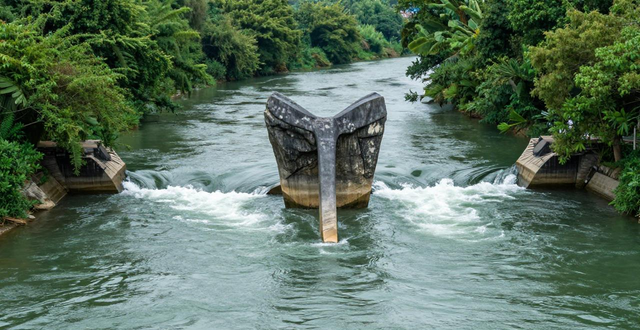
In today's Lingqu Scenic Area, you can see at a glance the large stone that looks like a plowshare, which is called the Plowshare. It is inserted straight into the Xiangjiang River, splitting the water coming from above, with three parts flowing into the Li River and seven parts flowing into the Xiangjiang River.
But that's not the best part.
The most powerful thing is the subsequent herringbone-shaped rolling water dam, which is the large and small scales. It is like a wise old man, accurately "weighing" the weight of water. Once the amount of water increases, it will overflow on its own to release the flood. If the amount of water decreases, it will block the water level to ensure that the boat can sail. How did people more than two thousand years ago calculate this angle? I stood on the dam and thought for a long time, and my mind was filled with questions.
All the twists and turns are the result of the mind’s eye
The North Canal is three to four kilometers long, but it is dug into a serpentine shape. People at the specific location at that time did not understand the concept of "slope ratio", but they knew that if the excavation was carried out directly, the water flow would be too strong and the boat would roll over.
Then turn the corner.
As we walked exponentially farther, the water flow slowed down. This kind of thoughtfulness is simply too much. Walking by the Bei Canal, looking at the winding waterway, I suddenly felt that the current overpasses were just like this.
Those disappearing troops
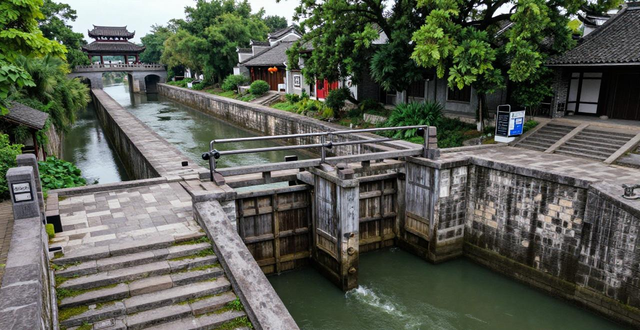
What shocks me most about Lingqu is actually the things that can no longer be seen clearly.
Take Doumen, for example, as the world's earliest ship lock, which was developed more than 800 years earlier than the West. Therefore, it is called the "Father of the World's Ship Locks". It appeared in the Tang Dynasty, with a total of thirty-six.
At that time, large ships from the Yangtze River arrived here. The water levels were very different and impassable. The soldiers immediately came down and used simple tools to block the gate and raise the water level, just like climbing stairs, going up step by step.
It wasn't until the 1930s, after the Hunan-Guangxi Railway was opened to traffic, that Lingqu Canal became increasingly deserted. Those families who had guarded the Doumen for generations had guarded a few key gates for a long time. What has become of the situation now? Has it changed? Their descendants chose to start a farmhouse business beside the canal, and lived a new life relying on guarding the ancient canal.
tree growing on stone
I have to talk about the piece of flying stone.
It stood alone on Qindi, almost four meters high, and the top split open and two sweet-scented osmanthus trees grew out. People say this is a stone that flew over from Sichuan to suppress demons. However, I believe that this stone has witnessed many things, including craftsmen building canals, merchant ships coming and going, and people who fled during the war.
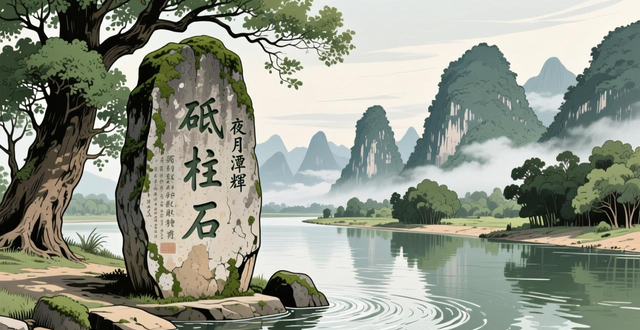
People from the Song Dynasty engraved characters on it. These characters are, "mainstay stone" and "night moon pool glow". In fact, it couldn't go anywhere at all. It stood here for two thousand years, watching people come and go, watching the water rise and fall.
living thing
There is one detail that touches me quite a bit.
What the local residents call "Douhe" is actually Lingqu. To this day, it still irrigates more than 60,000 acres of farmland on both sides of the Taiwan Strait. Every year when the water is dry, the Lijiang River also relies on it for water replenishment.
In 2026, the World Canal Conference will be held in Guilin. By then, the world's attention will once again focus on this inconspicuous river.
I think the "spirit" that Lingqu refers to is probably here. It has not evolved into a dull attraction like the Great Wall, nor is it like some ancient buildings that only survive in photos. It still has vitality, still plays the role of water, and still nourishes people.
At the moment of farewell, the setting sun reflected on the water, and an old man walked slowly passing by on a bamboo raft. He neither looked at me nor at the stone tablets, just like the people who had lived here for thousands of years. He only focused on the fish today.
After completing the Lingqu Road, Xing'an will have its own destiny. This is true.
Comments NOTHING