
Shadow puppetry: a living inheritance between light and shadow
The ancient skill of shadow puppetry, which is made of animal skin or cardboard carvings, originated more than 2,000 years ago. Images appear on the plain screen by the light of lights, and are manipulated by the hands of the artist to interpret the rise and fall of the world through the ages, and the joys and sorrows of the world.
Its production technology is extremely delicate, and its performance skills are very skillful and superb. It can be called a living fossil of our country's traditional drama.
Shadow puppet figures are extremely particular in terms of carving, with smooth lines and distinctive color contrasts. The light-transmitting parts and blocked parts can create a visual effect of virtuality and reality.
During the performance, one of the artists holds a stick in one hand to control the character, and hits the instrument with the other hand, while singing, chanting and beating. Just one person is like a play.
Facing the dilemma of shrinking audience base, in the current era of digital media, there is a comprehensive art form that integrates painting, sculpture, music and performance.
However, the value of shadow puppetry in contemporary times lies precisely in its unique on-site atmosphere and handcrafted qualities. Every time it is performed, it is an unrepeatable insight into life.
Protecting shadow puppetry is not simply about preserving the exquisite and wonderful figures, but about inheriting the folk wisdom that continues to flow within the scope of light and shadow and never stops.
The Art of Paper-cutting: The Art of Paper-cutting
Paper-cutting, this seemingly simple folk skill, actually contains profound cultural codes.
First use scissors or a carving knife to cut out the paper to form a shape. For the creator, he must be confident and resolute when cutting the knife, so that the lines can be continuous and the breath and charm can be connected with each other.
Originating from traditional paper-cutting, it is often seen in life scenes such as window grilles, fireworks, and embroidery backgrounds. Its patterns are mostly obtained from natural things and myths and legends, such as the pattern of goldfish playing with lotus, which means "more than one year after another", and the pattern of magpies climbing plum blossoms, which expresses the meaning of "happy eyebrows", all of which carry the people's yearning for a better life.
The core is not realism, which belongs to the essence of paper-cut art, but lies in image modeling. Artists rely on bold exaggeration and deformation to transform the three-dimensional space into a two-dimensional plane, and use symbolic language to convey auspicious meanings.
At this moment, the value of paper-cut art is being rediscovered. Its simple and bright line language fits perfectly with the concept of modern design, thus providing endless possibilities for the creative transformation of traditional crafts!
Embroidery Art: Cultural Memory Woven by Needle and Thread
The four famous embroideries are representatives of Chinese embroidery. There are many schools of embroidery in various places. These schools present a colorful situation. Together, they constitute a cultural history written with needle and thread.
Su embroidery is famous for its eight-character key points of "flat, even, fine, dense, even, smooth, harmonious, and light." Hunan embroidery pursues both form and spirit, Cantonese embroidery pursues full and lively compositions, and Shu embroidery pursues rigorous and delicate stitching techniques.
Embroidery works are created one by one, and they need to go through draft selection, stretching, drafting, wiring, then embroidery, and finally mounting and other more than ten processes.
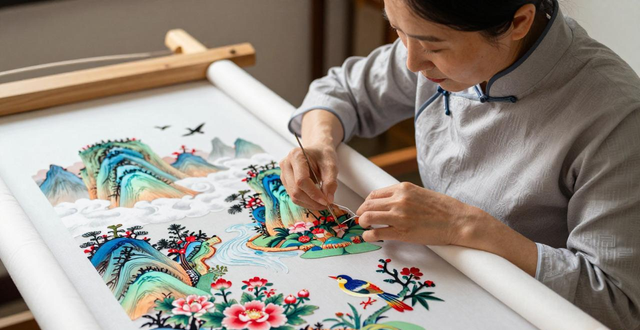
The needle is used as a pen by the embroiderers, and the thread can blend out the colors. The beauty of the mountains and rivers in the small area is once again presented, and the agility of the flowers and birds is also revealed.
What is particularly worth cherishing is that the embroidery skills that have been passed down from generation to generation lie not only in the mastery of techniques, but also in the quiet and focused craftsmanship. In the fast-paced modern life, this spirit of slow work to achieve fine results is itself a kind of persistence on a cultural level.
Clay sculpture art: life forms nurtured by clay
Clay sculpture art uses the simplest materials to create the most vital images.
Through the various moods in the market displayed by Tianjin's "Clay Figurine Zhang", through the auspicious meanings contained in Wuxi Huishan clay figurines, and also the colorful sculptures of gods and Buddhas in temples in various places, each of these clay sculptures shows the keen observation of life and the deep understanding of modeling by Chinese folk artists.
When creating clay sculptures, you need to choose clay that has good viscosity and just the right degree of dryness and moisture. Beat it and knead it to make the clay uniform. Then, you can shape it by hand-kneading or molding, and then paint it after it dries in the shade.
Relying on a pair of dexterous hands, the artist can instantly transform mud balls into characters with vivid expressions and animals with different postures. This ability to transform ordinary things into wonderful things is the most attractive charm of folk art.
Nowadays, 3D printing technology has become popular. However, the randomness and emotional temperature contained in handmade clay sculptures are particularly precious.
Opera Art: National Memory in Voices
As only one of the three ancient drama cultures in the world, Chinese opera has built an extremely shocking and magnificent art system with more than 300 types of operas.
From the polished elegance of Kun Opera, to the sonorous tone of Peking Opera, to the impassioned spirit of Qin Opera, to the graceful and gentle emotions of Yue Opera, every opera type embodies the temperament and aesthetics of a place.
Opera performances focus on the "Four Skills and Five Techniques". Among them, the "Four Skills" refer to the four performance skills of singing, chanting, acting, and fighting. The "Five Techniques" refer to the five technical methods of hands, eyes, body, method, and steps. They build a rigorous and flexible performance system.
The embroidery presented in the opera costumes is extremely exquisite, the colors contained in the facial makeup have symbolic meanings, and the props show the characteristics of virtual freehand brushwork. Together, they create an artistic realm, that is, "three or five steps can represent traveling all over the world, and seven or eight people can be used to embody millions of heroes."
At a time when film and television multimedia are extremely developed, the on-site nature of opera art, its unique sense of ritual, and the experience of emotional resonance between the stage and off stage are always irreplaceable by other art forms.
Those traditional folk crafts and performing arts are the aesthetic experience and spiritual wealth accumulated by the Chinese nation during its long history.
They have material or non-material forms and carry emotional memories. This emotional memory belongs to each generation and also carries cultural identity.
Riding the wave of modernization, we should treat these ancient skills with awe, not only to protect their core skills, but also to protect their spiritual connotation, and to promote the integration of the two with contemporary life, so that intangible cultural heritage can radiate new vitality during the inheritance period, so that these cultural genes that have traveled through time and space can continue to illuminate our path forward.
Comments NOTHING