
The taste of Jinmen’s hometown: a century-old legend of Tianjin snacks
When talking about Tianjin, we must mention the three wonders of Tianjin, which are famous all over the world.
This is not only a business card that expresses the taste characteristics of that land and water, but also a totem used in food that Tianjin people are most proud of deep in their hearts.
This time, the editor will lead you to go deep into the small alleys of Tianjin City to look for those fascinating and haunting delicacies with unique flavors, so that your trip in Tianjin will not only have a lot of fun, but also taste the delicacies very authentically.
Crispy and sweet 18th Street Twist
In Tianjin, the name of 18th Street Mahua is well-known.
Its story begins on 18th Street on Dagu South Road. Two brothers named Fan Guicai and Fan Guilin served as the founders. The two brothers opened a twist shop here respectively. Since the shop was built in this place, everyone used to call it "18th Street Twist".
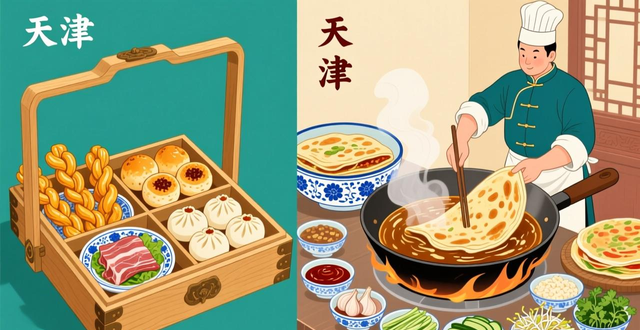
Different from ordinary twists, it is soft and sweet, and when you take a bite, it is crispy in layers with the compound aroma of various fillings such as osmanthus, Fujian ginger, and walnut kernels. It has various flavors, including traditional assorted ones, as well as innovative ones with salt and pepper, and five-nut kernels. Each stick is carefully twisted and fried just right. It is oily but not greasy in the mouth. It is an indispensable refreshment for Tianjin people when drinking tea and chatting.
Fried ear-eye cake with crispy outside and glutinous inside
This century-old snack originated during the Guangxu period of the Qing Dynasty.
The creator, Liu Wanchun, relied on his exquisite craftsmanship and extremely precise control of the heat to operate a stall at the exit of the narrow Er'eryan Hutong outside the north gate of Tianjin. Unexpectedly, this small fried cake gradually grew and grew in size, so people named it after the name of the alley.
The carefully selected ingredients for the ear-eye fried cake are extremely particular. The only choice is the finest and exquisite items, including yellow rice and red beans. To make them into finished products, they have to be soaked, ground into pulp, fermented, kneaded into balls, and filled with fillings. After so many processes, it is not finished yet. Finally, it has to be put into a frying pan and fried until it turns golden color.
The outer shell of the fried cake, freshly fried from the pot, is crispy and bubbly, but the inside is soft, glutinous and sweet. The bean paste filling is delicate to the point of being dense, and the sweetness is moderate.
Since its establishment in 1983, it has won honors many times. In 1997, it was recognized as a famous Chinese snack by the China Cuisine Association, and was listed as one of the three specialties of Tianjin along with Goubuli steamed buns and 18th Street Twist.
Half-fried Goubuli steamed buns filled with water
Speaking of Goubuli steamed buns , it has almost become synonymous with Tianjin tourism.
The steamed buns just out of the pot are like autumn chrysanthemums budding in the mist , white and soft, with well-proportioned pleats.
The authentic Goubuli steamed buns each have no less than 15 pleats, and this is precisely the most critical point that tests the master's superb skills.
Slowly bite it open, revealing a state that is rich in oil and water and as flexible as living water. The aroma is overflowing but there is no greasy feeling at all. The secret lies in its unique "water stuffing" process, which uses The stock is used to make the filling, which makes the meat filling tender and full of juice, and then combined with the semi-risen dough. The dough has the soft characteristics of the yeast dough and the chewy characteristics of the dead dough.
Talking about the origin of the name, it is also quite interesting: the nickname of the shop owner Gao Guiyou was "Gouzi". At that time, the steamed buns he made were extremely popular, and when he was busy, he did not bother to talk and socialize. So the diners jokingly called it "Gouzi sells buns and ignores them." As time passed, this friendly and unique name came into being.
Pancakes and fruits on the streets
Nowadays, pancake fruits are spread all over the country, but the most authentic roots are still in Tianjin.
According to rumors, it was passed from Shandong a hundred years ago and was improved by the dexterous hands of Tianjin people, ultimately creating its unique characteristics today.
The authentic Tianjin pancake fruit must be made with mung bean noodles, then beat two eggs, then sprinkle with chopped green onions, and then spread with sauce and hot sauce, and then add freshly fried fruit grates (thin crispy) or fried dough sticks.
When you bite into it while it's hot, the fragrance of the mung beans, the salty aroma of the sauce, and the crispness of the fruit grate blend together in your mouth instantly. And that kind of pure satisfaction that brings a sense of satisfaction is the most practical comfort in the early morning for Tianjin people.
Rich and mellow crispy rice dish
The flavored breakfast dish that Tianjin people love to greet is called "Gaba dish", but it is actually a rice dumpling dish, and this rice dumpling dish must be eaten while it is hot.
The method may seem simple, but in fact it is sophisticated: the pancakes must be thinned, cut into strips shaped like willow leaves, and spread on the bottom of the bowl; the key point is that the brine made in that pot must be brine with the batter washed out from the gluten, and then add more than a dozen kinds of small ingredients to cook it until it is thick and fragrant.
When eating, pour the hot braised rice on the rice crust, instantly stimulating the aroma contained in the food. Then top it with soybean curd juice, sesame paste, coriander, and spicy oil. Stir it evenly and put it in your mouth. The rice rice crust has a pliable feel and the marinade has a salty flavor. In summer, the rice crust dish made with mung bean powder has the effect of clearing away heat and relieving summer heat. It can be called Tianjin's unique breakfast concept.
A collection of sugar-roasted chestnuts from Jinmen
Although Tianjin is not a place where chestnuts are produced, the best quality Liangxiang chestnuts and Zunhua chestnuts in China are gathered here for sale. Under such circumstances, the reputation of "Tianjin chestnuts" spread quickly and without any hindrance.
In autumn and winter, there are always long queues in front of the sugar-roasted chestnut stalls on the streets.
In the large iron pot, the shiny black sand, sugar, and chestnuts are tumbling together. In the steaming state, it exudes the sweet smell of caramel.
When the chestnuts are freshly taken out of the pot, their shells are shiny. When you pinch them with your hands, the shells will crack and the meat inside will come out. The chestnut meat is golden in color and has a soft and sweet texture. It is steaming towards your mouth. It is the warmest happiness in the whole winter, held in the palm of your hand.
Tianjin wontons with thin skin and large fillings
Wontons can be found everywhere, why are Tianjin’s so famous?
The secret lies in the word "big".
Tianjin wontons have large fillings, thin skin, and are very generous in size. The meat fillings are hand-made with fresh pork and onion and ginger seasonings. They are firm and elastic.
The soup base is particularly particular. Most people use chicken soup or pork rib soup, which is cooked for a long time. The color of the soup is clear, but the taste is mellow.
Put the cooked wontons into a beautiful and exquisite bowl, then sprinkle with finely shredded egg skin, seaweed, winter vegetables and coriander, then carefully add a few drops of fragrant sesame oil, then eat the wontons in one bite, and then take a sip of the soup. The taste is incomparable.
These traditional well-known stores called Zhimei Zhai and Zhoujia Canteen, which bring wonderful taste experiences to the public, have accumulated over time and carry the taste memories of generations of people in Tianjin.
Tea soup in a large copper pot with a dragon's mouth
Cha Tang is a sweet street drink similar to lotus root starch, but made from millet noodles.
The most attractive thing is the large copper kettle with a shiny dragon mouth .
The master holds the bowl with one hand and supports the pot with the other. The hot boiling water pours out quickly from the long spout and rushes into the bowl accurately. The millet noodles are cooked in the blink of an eye. The whole process is as smooth as clouds and flowing water, which is very enjoyable to watch.
For the prepared tea soup, sprinkle brown sugar, then white sugar, then green roses, some sesame seeds, walnut kernels and other small ingredients, and then scoop it up with a small spoon to eat. It tastes delicate and smooth, and the taste is sweet and moist. Every bite is full of the fun of childhood.
Rich and exquisite four steaks and eight bowls
This Han folk banquet form became popular in Tianjin in the 1830s.
The four big steaks do not specifically refer to four dishes. To be more precise, they are "grilled" dishes made from ingredients such as whole chickens, whole ducks, elbows, and sea cucumbers. They cover a wide range of things and are varied; while the eight big bowls use large bowls to hold the corresponding dishes. The cooking methods are mainly stew, grill, and stew. The portions are full and the taste is rich and mellow, which is very conducive to people from all social classes to enjoy it.
At that time, the Ershi Restaurant in Tianjin could book high-end banquets, and could also receive individual guests. It relied on its expertise in cooking these dishes known as the "four big steaks and eight big bowls", so the business was extremely prosperous, fully demonstrating the tolerance and generous character of Tianjin's catering.
Four winter treasures that are limited in season
Tianjin people know how to eat and are extremely sensitive to seasonal ingredients.
The four most precious delicacies in winter are the so-called<strong>Four Winter Treasures , they are respectively<strong>Iron Bird, Whitebait, Purple Crab, Leek Yellow .
A type of sparrow is called a sparrow, which is caught in winter and then deep-fried. It has a crispy, dry and fragrant texture and is an excellent snack. Whitebait is a specialty of the north. The most common method is to dip it in egg white and fry it to become a whitebait lump. It has the characteristics of crispy on the outside and tender on the inside. It has a unique fragrance; although the purple crab is as small as a copper coin, the crab roe is very plump. Put a few in the hot pot, and the umami flavor of the soup will be increased tenfold immediately; as for the dish of fried eggs with chives, although it is a home-cooked dish, it becomes particularly delicious because of the freshness of the chives in winter.
These four treasures are nature’s highest gift to Tianjin people’s winter dining table.
Comments NOTHING