
On the subway during the morning rush hour, more than half of the people watch short videos.
At 7:30 in the morning, at Changying Station of Beijing Line 6, crowds of people poured out of the train like a tide.
Xiao Zhou was leaning on the armrest next to the car door. A certain blogger's "immersive homecoming vlog" appeared on the screen of his mobile phone, which included exquisite tableware, warm yellow lights, and healing music.
She looked at it twice, and then switched to another account: a live broadcast was being conducted to sell mobile phone cases worth ninety-nine yuan, and the host was shouting until his voice was almost hoarse.
"Good-looking things are too cheap." Xiao Zhou told me later.
She lives in a second bedroom in an old community in Tongzhou and rents a house. The monthly rent is set at 1,800 yuan. The most valuable item in the house is a Dyson hair dryer purchased in installments.
The IKEA-style scented candle was placed on the bedside table. It cost 29 yuan and included free shipping on Taobao. After lighting the candle, she said, "the room felt a little more upscale."
Not just Xiao Zhou.
The lady who sells pancakes down the street reads, "5 yuan has arrived in Alipay - ding, the day full of energy has begun."; Mr. Tony in the adjacent barber shop has "cross-dressing videos" of herself dyeing her hair on the top of Douyin; even the old man who plays chess at the gate of the community has dozens of short videos with funny dubbing stored in his mobile phone, "just to get that joy."
Art is too far away, life is too close, everything is available on your mobile phone
In the past, when we talked about "art", we meant going to art galleries, listening to concerts, and watching plays.
It's different now.
Lao Zhang has worked at a construction site for twenty years and has never attended any art exhibitions.
But after he finished work every day, he would watch people painting wall paintings on Kuaishou.
An anchor known as "Brother Qiang" was obsessed with painting landscapes and animals on the walls of the countryside. Lao Zhang watched with great interest.
"That painting is really good, just like the real thing." He said.
He had never thought about the possibility that the cement walls he passed every day could become "canvases."
There are more people looking for the definition of "beauty" on Douyin and Xiaohongshu.
There are beauty bloggers who teach people how to apply makeup called "plain water makeup", there are fashion bloggers who tell everyone what "Clean Fit" is, and there are home bloggers who show off minimalist living rooms with the words "the high-end sense of ordinary people's homes."
These are far from traditional "art", but they still permeate into the lives of people who are not happy at all. They need to make the dishes look good for breakfast, adjust the filters for selfies, and buy a few paintings to cover the mold spots on the wall in the first month after moving.
"Everything can be turned into consumer goods now," said Lin Na, a white-collar worker at Guomao.
On the weekend, she went to Chaoyang Joy City, where there are many different designer brands on the first floor, a cultural and creative market on the first floor, and even the dining area is decorated like an art gallery.
The light illuminates the place just right for you to sit there and eat a bowl of noodles. There is a book of poetry on the table, and abstract paintings are hung on the wall. It seems that what you are eating is not the noodles, but an atmosphere. Yes, that's what it feels like.
I can’t understand avant-garde art, but “ready-made products” don’t seem to be that difficult to understand.
In the 798 Art District, there is an exhibition in which many old tires, broken sofas and scrap iron sheets were piled together, and then named "Urban Edge".
Several young people stood at that place and took pictures. One of them said, "Isn't this the same situation as the land that was demolished in my hometown?".
It does look like.
Those cutting-edge artists were no longer satisfied with canvases and paints. They moved existing objects in their lives into the exhibition hall. Here is an old and broken chair, there is a stack of newspapers from the past, and there is a faucet with a rusty surface.
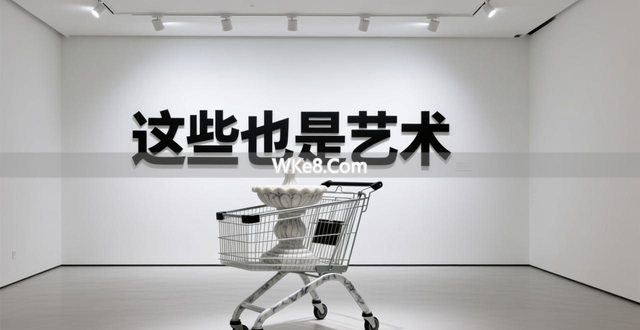
What they want to say is: these are also art.
But what is more true is that ordinary people have already understood the logic of this "ready-made object".
In the Panjiayuan flea market, some people transformed old-fashioned sewing machines into tables, some used enamel jars as pen holders, and some framed food stamps and hung them on the wall.
There is a cafe in Xisi Hutong that uses old Beijing door pillars as stools and wooden window lattice as partitions.
The boss said that those things originally existed in life, but they just changed places and continued to exist.
Sister Li has been running a barber shop in Fangzhuang for 20 years. She recently renovated the shop.
She did not go to a designer, but relied entirely on watching short videos to learn. She used an old wooden box as a coffee table, transformed a sewing machine head into a mirror frame, and hung a bamboo dustpan brought from her hometown on the wall.
The guests who came here said they had that unique taste. I didn’t know what art was, I just felt that the things in front of me looked really friendly.
Life is the biggest exhibition venue. Who can still tell what is art and what is life?
Here comes the question: when everything can become "beautiful", what is left of beauty?
In an old community in Nancheng, Beijing, Grandma Wang sunbathes downstairs every day.
Her aesthetic requirements are quite simple, that is, the flowers bloom bright enough, the clothes are bright enough, and the paintings painted by her grandson are plastered all over the refrigerator.
She doesn't use Little Red Book, and she doesn't know what "aesthetic generalization" means. However, she will point to the newly planted roses downstairs and say: "This flower is really beautiful, and I feel happy looking at it.".
This is the simplest answer - beauty is not hung on the wall, beauty lasts for a long time.
At six o'clock in the evening, people after get off work poured out of the subway station.
There was a queue in front of the pancake stall, and the aroma wafted far away.
People walking on the street turn on their mobile phones to watch a short drama that can be used for dinner; people holding their mobile phones take pictures of the sunset and post on WeChat Moments with the text "Today's cure"; people in the vegetable market are picking and choosing, thinking about what delicious food to make in the evening.
In the vegetable market, the tomatoes are shiny red, the vegetables are green and fresh, and the fish in the aquatic area are still flapping in the water.
The eldest sister holding the vegetable picked up a cucumber, looked at the light, and said: "This cucumber is very good, straight and smooth." She doesn't talk about the so-called aesthetics, but she understands what is good.
This is the life aesthetic of contemporary Chinese people. It is not in a high-altitude state, nor is it far away from the smell of fireworks. It is hidden in every ordinary detail, hidden in the filters on mobile phone screens, hidden in the aromatherapy of rental houses, hidden in the renovation of old things in alleys, hidden in the fresh vegetables in the wet market.
It's not perfect, it's not refined, it's even a little rough.
But it's real.
It was as if he said: "What is art and not art? That's what Lao Zhang, who has worked on construction sites all his life, said. It would be great if you could make your life a little more interesting."
At ten o'clock in the evening, there were still people awake in the community.
Some people are doing swiping operations in the live broadcast room, some are watching in the field of short videos, and some have just returned from get off work with a cold skin in their hands.
Outside the window, the moonlight shines faintly.
In the window, the light of the mobile phone screen is shining.
In those lights, there are countless people’s expectations for a “better life.”
Comments NOTHING