
The vegetable market after get off work is what life is really like
At 6:30 in the evening, the Tuanjie Lane vegetable market ushered in the busiest time of the day.
Young people who had just finished work, carrying reusable bags, crowded in front of vegetable stalls, and the sounds of short videos from the Douyin application were playing on their mobile phones.
Lao Zhou, the tofu seller, was closing the stall. At this moment, there were only two pieces of tofu left, and a sister who came often handed all three yuan to Lao Zhou: "Take it quickly and take it back to fry. The tofu that appears in the early morning is not as good as this!" Not far from here, at the entrance of the roast duck restaurant, there was a queue of seven or eight people. The duck that had just been baked was dripping with oil, and the duck gave out a pleasant fragrance, which penetrated into the noses of everyone who passed by.
Xiao Li, an office worker, was queuing in line while sending a WeChat message to his colleagues, saying: "There will be guests at home tonight, go buy a roast duck, add a cucumber, and it will be complete."
This kind of urban fireworks happens on time in every Chinese city in the evening.
To feel the texture of life, nothing is more representative than the wet market - the sound of bargaining, the rustling of plastic bags, and the sound of water splashing in the fish pond. These are intertwined and are the most authentic reflection of people's livelihood. They are where people's livelihood is, the real scene of life, and the place full of texture.
Those theories about " the aestheticization of daily life " seem distant here.
For the vast majority of ordinary people, beauty does not exist in inscrutable discussions, but in the sense of solidity they have when buying fresh ingredients, and the feeling of satisfaction they experience when their families sit around and eat together.
Parks on weekends hide the spiritual world of ordinary people
At seven o'clock on Saturday morning, People's Park was already full of people doing morning exercises .
There are square dancing ladies in uniform costumes, with Phoenix Legend playing on the speakers; Lao Zhang, who is wearing cloth shoes and doing Tai Chi, moves in an unhurried and orderly manner; at the pavilion by the lake, a few retired old people are setting up the chessboard, and the onlookers are more anxious than the chess players.
The young mother with her child was pushing a stroller , and the child pointed at the goldfish in the lake and babbling.
Xiao Chen, the delivery boy, rarely had time to rest. He sat on a bench, scrolling through his mobile phone in his hand, occasionally looking up at the sky, and said: "I have to run 28 days a month, and I can finally get some sunshine today."
These scenes appear every day, and their simplicity makes people almost forget them. This is also part of the "aesthetic".
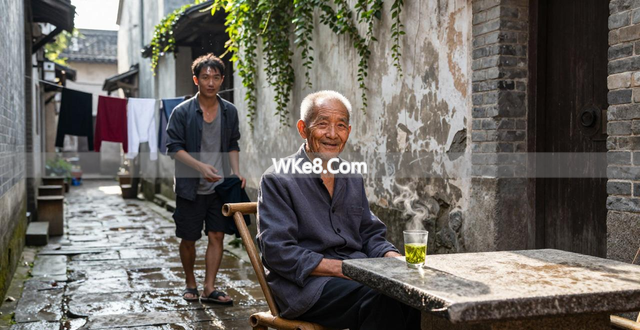
Chinese people have always attached great importance to showing their temperament in daily life, even if it is just a cup of tea, a game of chess, or a piece of opera, they all contain the pursuit of spiritual pleasure.
The pleasure of participating in square dancing is not simply limited to the physical movement process, but also comes from social needs and emotional expression; the fun brought by chessboard games and watching chess does not only depend on the final outcome, but on the concentration invested and the resulting resonance.
This kind of beauty is based on the senses, but it does not stop at the senses. Sweating makes people feel comfortable, and basking in the sun also makes people feel comfortable. However, in this comfort, there is a love for life, a cherishment of health, and a reliance on the fireworks friendship between people.
The lamp at home is the final destination
At nine o'clock in the evening, warm light shines from the windows of the old community .
In the rental house , Xiao Zhang, who had just finished working overtime, opened the takeout app and was hesitant about which restaurant to order.
The sound of cooking and TV news came from next door, and the smell of oil smoke drifted in through the window.
He thought of the braised pork cooked by his mother in his hometown, and suddenly felt a little hungry and homesick.
There is a canteen downstairs, and its boss is still there at the moment. Some migrant workers are sitting there in front of the canteen. They are shirtless and chatting, and they are chatting while drinking beer.
They talked about the work at the construction site, the money for their children to start school, and whether they could go home during the New Year.
The boss interrupted from time to time and handed over a plate of peanuts.
This is the daily life of countless Chinese families .
The bouquet of flowers I bought on the way to get off work, the pots of green plants planted on the balcony, and the carefully cooked meal on the weekend. These small and devoted moments are the foothold of aesthetic activities in ordinary people's lives.
It is not a utopia divorced from reality, but the light of real life itself.
Those who exist, beautify the aesthetics of daily life in one way or another, but simply understand it as sensory pleasure and extravagant and wasteful consumption. In fact, they have deviated from the original correct direction.
The real beauty is never far away from life, but in the deepest part of life.
When you take a sip of hot soup when you are tired, receive a call from your family when you are lonely, and lie down in a warm bed after a busy day, the comfort and satisfaction you feel at that moment are the most simple aesthetics.
It does not require profound theories or high costs, it only requires us to spend every ordinary day with our heart.
Comments NOTHING