
Are you still envious of Tao Yuanming’s days of “picking chrysanthemums under the eastern fence”? In fact, there is no need to retreat to the mountains and forests. These pastoral poems that have been circulated for thousands of years can suddenly transport you back to a paradise where you can hear the sounds of chickens and dogs and the smoke slowly rises from the kitchen. The 120 classic poems compiled today will help you understand the pastoral complex hidden in the bones of the Chinese people.
Farming hard work and sweat
Daily life at sunrise
Everyone has recited this poem "It's noon on the day of hoeing, and sweat drops from the hoeing soil." Li Shen used the most straightforward language to describe the scene of farmers bending down to hoe at noon, and sweat dropped drop by drop to the hoeing soil. In the soil below the seedlings, this kind of scene is still relatively common in rural areas today. In 2023, Uncle Zhang from a village in Henan Province said that after working in the fields for one hour in summer, moisture can be squeezed out of the clothes.
Persistence that shines like the stars and the moon
The ancient Tao Yuanming wrote in "Returning to the Garden and Living in the Fields" that "when you wake up in the morning to sort out the filth, you will return home with a hoe under the moonlight", which means that when it is still dark, you will go down to the fields to clear weeds, and will not return home until the moon rises, carrying the hoe on your shoulders. In Linyi, Shandong Province, many farmers are engaged in the work of growing vegetables in greenhouses. In winter, they need to enter the greenhouses at four o'clock in the morning to carry out picking operations, and they can not finish work until seven o'clock in the evening and go home. This situation maintains the same rhythm as the ancients thousands of years ago.
Picturesque pastoral scenery
colorful fields
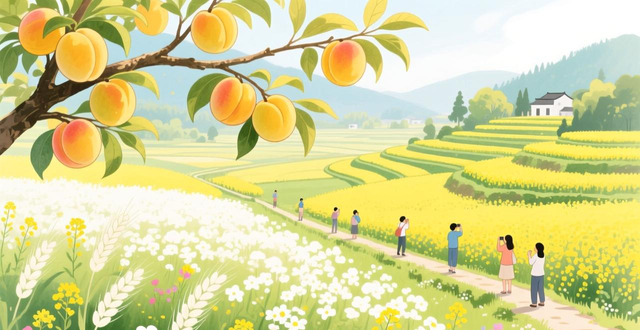
Fan Chengda wrote "The plums are golden and the apricots are fat, the wheat flowers are sparse and the cauliflowers are sparse." The two colors of golden and snowy white are used to depict the harvest scene in the early summer countryside. During the May Day holiday in 2024, the terraced rapeseed flowers in Wuyuan, Jiangxi Province attracted hundreds of thousands of tourists to watch. What everyone saw was this yellow and green field picture.
Smart and vivid creatures
In Wang Wei's "Jiyu Wangchuan Zhuang Zuo", "Egrets fly in the desert paddy fields, and orioles sing in the shaded summer trees." The white egrets are flying gracefully above the paddy fields, while the orioles are singing gracefully in the shade of the trees. In Deqing, Zhejiang In the rice fields of the area, ecological agriculture has been doing quite well in recent years, and the egrets have flown back again. Local farmers say that during the rice transplanting season, they can see hundreds of egrets following the plows looking for bugs to eat.
Country life favors
The warmth of neighborliness
Li Bai said in "Going down Zhongnan Mountain and passing through Husi Mountain, people stay and buy wine", "When we go to Tian's house together, children open their doors." It was when his friends led him to the farmhouse, and the children happily opened the wood door to welcome him. In the Miao Village in southeastern Guizhou, whenever tourists arrive, they are often enthusiastically dragged into their homes by the villagers for a meal. This simple and hospitable attitude is exactly the same as what is described in the poem.
self-sufficient satisfaction
Meng Haoran wrote in "Crossing the Old Friend's Village" that "an old friend brought chicken millet and invited me to Tian's house." The old friend slaughtered the chicken and cooked yellow rice, and also invited him to his home as a guest. This custom of using home-grown food and home-raised chickens to entertain guests is still preserved in the rural areas of Hebei. During the Chinese New Year, families invite each other to have meals together, and the bacon on the table is all smoked in the previous winter.
The seasons change
The rhythm of spring plowing and summer hard work
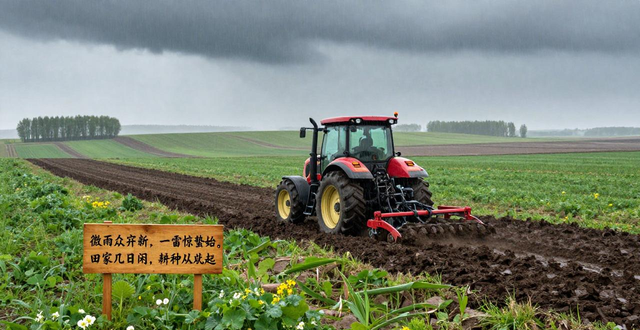
Wei Yingwu wrote in "Guan Tian Jia", "A light rain brings new flowers, and a thunder starts to wake up the insects. The fields are idle for a few days, and farming begins." After the spring rain comes, the flowers and plants take on a new look, and the thunder begins to wake up, and farmers immediately start busy farming activities. In the Great Northern Wilderness of Heilongjiang, large tractors equipped with GPS navigation are currently used for spring plowing. However, the time node is still around the time before and after the Waking of Insects, and the solar terms have never changed.
The expectation of autumn harvest and winter storage
Xin Qiji wrote, "The fragrance of rice flowers means a good year, and listening to the sound of frogs", through the fragrance of flowers floating in the rice fields, and the croaking sounds of frogs, I have a premonition that this year will be a good harvest year. In August 2024, Brother Li, a major grain grower in Huaihua, Hunan, stood on the field ridge and said that the louder the sound of frogs, the more at ease he felt, and that one acre of land could harvest 1,300 kilograms of rice.
Feelings of seclusion
Desire to escape from prison
What Tao Yuanming said, "After being in a cage for a long time, you can return to nature" expresses the inner thoughts of many office workers. He compared the officialdom to a cage, and returning to the countryside is like a bird flying back to the forest. A survey in 2023 showed that more than 60% of urban white-collar workers have had the idea of returning to rural life, and it is this kind of freedom that they yearn for.
simple pure happiness
In "Out of the Suburbs", Yang Shen wrote something like "High fields are like stairs, flat fields are like chess boards", comparing the terraced fields on the hillside to things like stairs, and the fields on the flat land to things like chessboards. In Yuanyang, Yunnan, the terraced fields cultivated by the Hani people for generations have now become a world heritage site. A local young man gave up his job in Kunming and returned to his hometown to farm. He claimed that looking at these "staircase"-like terraced fields every day would make him feel at ease.
Thoughts on dialogue between ancient and modern times
Lost memory of farm tools
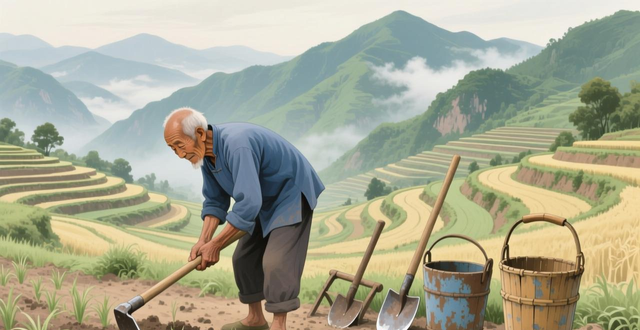
That person was once described by Zhang Ji in "Old Songs of the Wild" as "a poor old farmer living in the mountains, cultivating three or four acres of mountain fields" to describe the image of an old farmer who made a living on a few acres of thin farmland. Nowadays, young people in rural areas basically do not know how to use agricultural tools such as hoes and rakes. A 65-year-old farmer in Shaanxi told a story that his family's stone mill, which had been in use for 30 years, was bought by a city dweller for 500 yuan and put up as a decoration.
Unchanged land complex
According to what Lu You wrote in "Guancun Children Playing on the Stream", "Three winters are temporarily spent on Confucian studies, while thousands of couples are still farming with their parents." Children carry out reading and learning activities in winter, but in other seasons, they still need to follow their parents to work in the fields. Nowadays, although many rural children do not need to be engaged in farming-related matters every day, when they return to their hometowns during winter and summer vacations, their grandparents will still take them to the vegetable garden to teach them about various vegetables. Such a deep-rooted understanding is difficult to change.
What is the most beautiful pastoral scene in your mind? Is it the old locust tree at the door of your hometown, or is it that afternoon chasing dragonflies in the rice fields? Welcome to show your rural photos in the comment area, like and forward them so that more people can see the beauty of China's countryside.
Comments NOTHING