
For some unknown reason, when the Hui people are mentioned, the first word that comes to many people's minds is "don't eat pork." What happens after that? There was no follow-up after that. In fact, this situation is quite regrettable. The various stories of a nation that has settled in the vast land of China for more than 1,300 years have been so easily and casually simplified into a label that only concerns food.
To be honest, that’s where the misunderstanding comes from.
If you have ever seen the afterglow pouring on the green dome of the mosque at dusk, you will understand the power of silence. The "peace" of the Hui people is not weak and weak, but a peace with confidence in their hearts. His ancestors followed the Maritime Silk Road from distant Arabia and Persia, settled in Fanfang in Guangzhou, and engaged in commercial activities in the port of Quanzhou. Gradually, they regarded the foreign land as their hometown.
When "Se Liang Mu" sounds
The first time I visited my friends in the northwest, I was "shocked" by their etiquette.
It's not the kind of polite welcome. This kind of welcome is that after you step into the door, the whole family, from the elderly to the children, will really come over to greet you one by one. Their eyes will look at each other and their smiles will be full of sincerity and no falsehood. They will physically smile. Lean forward slightly and bend your upper body to salute, and then say "色两目". At that moment, you will feel that you are not just a guest, but a person who is treated seriously and fully accepted into this family.
Time soaked in Babao tea
When an old man comes, he must sit on the hot bed, the most distinguished seat.
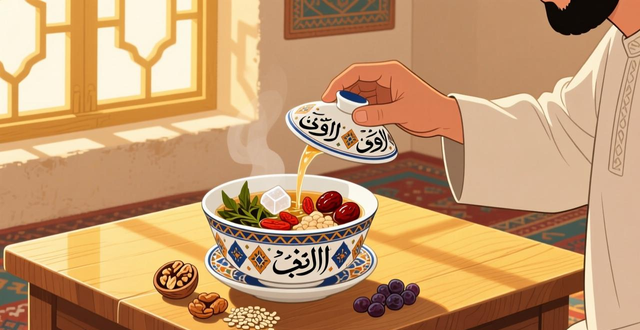
The tea presented subsequently is called "Eight Treasures Tea" or "Five Spice Tea". Don't underestimate that bowl of tea. It is soaked with tea leaves, rock sugar, wolfberry, red dates, walnut kernels, longan, sesame seeds, raisins... You need to use the lid to slowly scrape it to drink.
Every tooth has a different charm, as if it is very similar to those scenes in those days, and it seems to be exactly the same as the intention that people give to others - unhurriedly, slowly warming you up.
Those rules about "eating"
There are always people on the Internet who are curious, and some even argue: Do you think pork is poisonous?
Not so. Absolutely not the case. This matter is not that complicated, nor is it that mysterious. For Muslims, dietary taboos are a concept of “cleanliness” deeply rooted in their faith. Not only is pork excluded from the diet, but also items that die on their own, blood, and things that are slaughtered without reciting the name of Allah are also excluded from the diet.
This kind of self-discipline appears as a constraint in the eyes of outsiders, but to them, it is part of their own inner order.
Flowing water is clean
One detail particularly touched me.
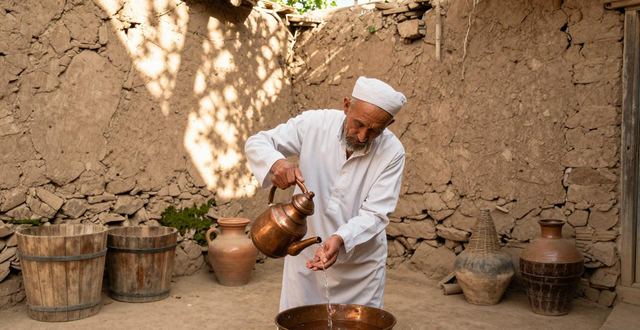
When they wash their hands, they must use water that is not stagnant but flowing back and forth. Even if they are in extremely poor conditions, they have to use water from the kettle to wash their hands. They will never use stagnant water in the basin to wash their hands. This persistent attitude towards cleanliness has been deeply imprinted in their daily lives.
You must wash before and after eating. See, this is their lifelong habit of pursuing a dynamic, never-ending cleansing.
Even if it is a farewell, it must be done solemnly
You've been at their house for a day and it's time to leave.
It's not as simple as just turning around after delivering it to the door. If the village is not too big, in this case, they will accompany you slowly, passing through alleys, and finally take you to the wide road at the entrance of the village. If you meet a distinguished guest from afar and receive special hospitality, you will even be sent as far as the boundaries of the town.
This kind of farewell with an ancient flavor seems to convey the meaning that the journey you have traveled when you came here is very long, and the journey I want to send you off will also be longer.
The hardness and softness in the bones
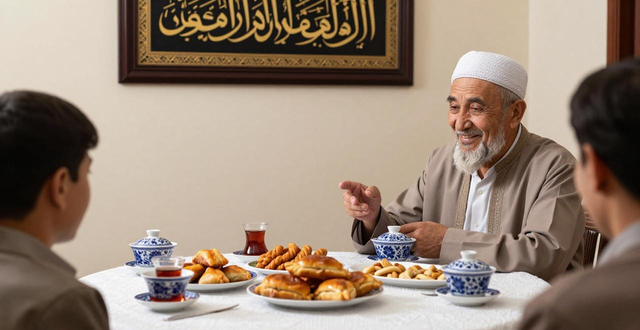
Some people may think that living with so many rules is not tiring?
But if you look at their past experiences, they were first the expatriates in the Tang and Song Dynasties, then the Huihui armies in the Yuan Dynasty, and then the farmers and businessmen who took root in this land during the Ming and Qing Dynasties. Being in a completely unfamiliar environment, you have to stick to your beliefs and get along well with the people around you. If you don't have some inner perseverance and gentleness towards others, you won't be able to survive.
The awe hidden in daily life
In the final analysis, the charm of the Hui people does not lie in those grand narratives.
It's in this bowl of tea, a look, a greeting, and a long journey.
They rely on the most trivial and complicated daily life to protect the most sublime and solemn awe in their hearts. This unique tension and the harmony in such contradictory situations are precisely the most charming thing about this nation.
Even if you are in a market place with noisy people, as long as you hear the long sound of the adhan coming from the mosque, you will put down what you are doing and become quiet. At that moment you will clearly know that peace is never given by the outside world, but grows from deep within.
Comments NOTHING