
Not a city, but an entire galaxy falling into the desert
If you think that Jiuquan is Jiuquan, you are wrong. Big mistake.
An area of 192,000 square kilometers, what kind of concept is this? Zhejiang Province has an area of two, and they are placed at the western end of the Hexi Corridor. However, there are only more than 1 million people living here. The sparsely populated area here is so vast that it’s terrifying. After driving for several hours, the desert outside the car window always looks like it has never changed. Is this area desolate? The answer is yes, it is indeed desolate. But it is precisely this desolate situation that contains something extremely remarkable.
Jiuquan, where is it?
Opening the map, at the intersection of the four provinces of Gansu, Xinjiang, Qinghai and Mongolia, it actually borders Mongolia to the north. Qilian Mountain plays a supporting role in the south, and Mazong Mountain sits quietly as if squatting in the north. This narrow strip between the two has been the chokepoint since ancient times.
It is connected to Zhangye to the east, Xinjiang to the west, Qinghai to the south, and Inner Mongolia and Outer Mongolia to the north. Connecting the east to the west, connecting the south and expanding the north - this is the way of expression in the textbook. However, when you stand there, you will understand that this kind of place is born for stories to happen, not just passing by.
The administrative divisions here are about 100 million points in size
There are two cities and four counties within the scope of the first district, including Suzhou District within the city, Yumen City, Dunhuang City, Jinta County, Guazhou County, Subei County and Aksai County.
It is common for more than 40 ethnic groups to live together. There are Han people, Mongolians and Kazakhs living here. Here in Subei, you can hear the sound of the morinouqin. In Aksay, the aroma of Kazakh milk tea is wafting.
Dunhuang Mogao Grottoes: Not here to see the Buddha statues, but here to be penetrated
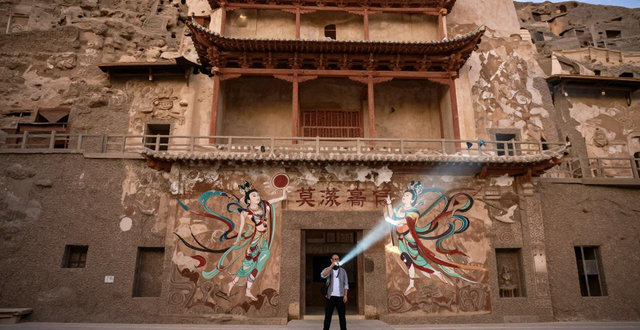
Dunhuang Mogao Grottoes are excavated on the cliff of Mingsha Mountain. There are as many as 735 caves, with a total mural area of 45,000 square meters and more than 2,000 colored sculptures. Although these numbers seem cold, once you actually step into those caves, when the beam of flashlight passes over the wall, Feitian seems to come alive in an instant, and its eyes are looking directly at you - at this moment, you are no longer a tourist, but a chosen one.
Including the ruggedness of the Northern Wei Dynasty, the plumpness of the Sui and Tang Dynasties, the exotic customs of the Xixia Dynasty, etc., the beliefs of more than a dozen dynasties are stacked here, with one layer of murals covering another layer of murals. Yu Qiuyu once wrote that visiting the Mogao Grottoes is not to see specimens that have been dead for a thousand years, but to see lives that have been alive for a thousand years. This is the truth.
Mingsha Mountain Crescent Spring: Why is the desert so romantic?
It used to be called Shensha Mountain. It stretches for forty kilometers in the east-west direction and twenty kilometers in the north-south direction. It is dozens of meters high. Moreover, the entire mountain is completely made of yellow sand in the shape of rice grains.
Climbing up the sand mountain is really tiring. Every time you take two steps forward, you have to take one step back. However, after climbing to the top after all the trouble, you can look down at the crescent-shaped crescent-shaped place at the foot of the mountain, which is called the first spring in the desert. It has never dried up! What is the reason for this? Scientists say it is due to terrain conditions, but local residents say it is caused by love.
Even more wonderful is the starry sky concert held in the summer with tens of thousands of people scattered on the piled sand mountains. The lights of many mobile phones light up one by one, and they roar along with the music. At that moment, you will feel that the entire vast universe is accompanying you into a state of madness.
Dongfeng Aerospace City: The world closest to the stars
To the north of Jinta County, deep in the Badain Jaran Desert.
Construction of China's earliest and largest space launch center began in 1958. The first artificial satellite was born here, the first manned spacecraft was held here, and the first space walk was conducted here... The dawn of the Gobi Desert was pierced by countless "firsts" here.
When the Shenzhou spacecraft was launched, the flames could be seen rushing toward the sky dozens of kilometers away. The ground beneath my feet was shaking, and something in my heart flew upwards with it.
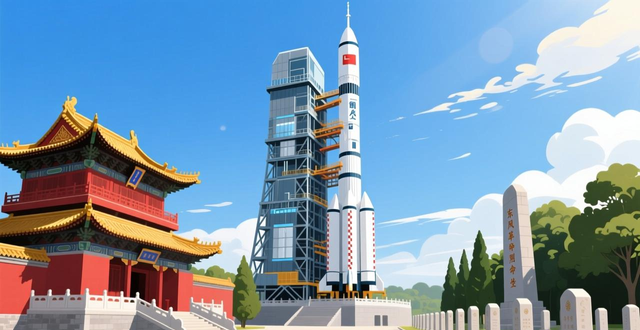
The huge tower that carries Wentian Pavilion and manned launches, the cemetery of the Dongfeng Revolutionary Land, and those who left their lives here are buried in the cemetery, including some who are still young. Their tombstones face the direction of the launch tower, always watching the rocket soar into the sky.
Yumenguan: The spring breeze really never blows
90 kilometers northwest of Dunhuang, on the south bank of the Shule River in the Gobi Desert.
From the 2nd century BC to the 3rd century AD, all that remains of the pass set up by the Han Dynasty is a square mound. However, it is precisely this mound that appears hundreds of times in Tang poetry. In the poem "Why does the Qiang flute blame the willows? The spring breeze does not pass through Yumen Pass." Here, Wang Zhihuan did not lie. The feeling of the wind blowing on his face is indeed very strong.
Standing there, there was nothing else around, only the wind, only the sand, and only the same sunset that the soldiers had witnessed two thousand years ago. Suddenly, I understood what it means to "come out of Yangguan in the west and have no old friends."
Yadan Geopark: Scream of the Devil City
It is at the junction of Xinjiang and Gansu, more than 80 kilometers away from Yumen Pass.
The typical Yadan landform is an earth forest formed by wind erosion. It looks like a fleet, like a castle, and like an alien surface. When the wind is strong, the mounds can make sounds like ghosts crying and wolves howling, hence the name Devil City.
It is best to enter in the evening, when the setting sun dyes everything in the world blood red, and the light and shadow show strange changes. If you take a few steps forward, you will seem to fall into a completely different dimension on the other side.
Jinta Populus Forest: Autumn burns here
8 kilometers northwest of Jinta County.
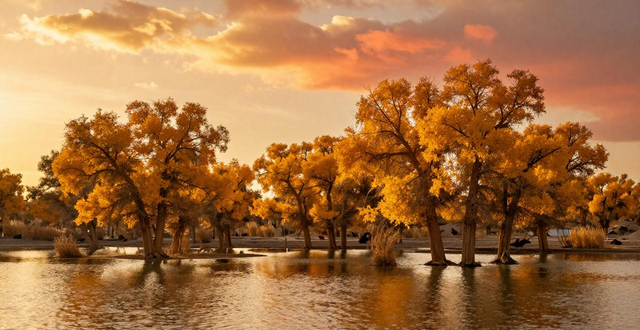
The largest artificially cultivated Populus euphratica forest in the northwest. In the spring and summer, it looks very normal green, but once October enters, it seems like you are in a crazy situation. The whole tree turns golden, and its reflection is reflected in the sparkling Jinbo Lake. The sky is golden, and the lake water is also golden. When you stand there, your whole person is completely filled with gold.
While alive, Populus euphratica can survive for thousands of years, and even after death it can stand for thousands of years. After it falls, it will remain immortal for thousands of years. Although it is just a rumor, in the autumn of every year, there are always some people who are willing to travel thousands of miles just to witness this golden and heroic scene, as if they are rushing to their death.
There is another place: Jiuquan Scenic Spot in the Western Han Dynasty
In Suzhou District, the legendary spring is still there.
In 121 BC, Huo Qubing achieved great victory against the Xiongnu, and Emperor Wu of the Han Dynasty rewarded him with royal wine. Since the quantity of wine was quite small but the number of soldiers was large, General Huo poured the wine into the spring and then drank it with the soldiers. This is how the name Jiuquan came about.
More than two thousand years have passed, and the spring water is still flowing out. Sitting next to the spring, closing your eyes, it seems that you can still hear the laughter of those young soldiers.
As I write this, it is getting dark outside the window.
Suddenly I remembered Li Bai's poem:
"If heaven did not love wine, the wine star would not be in the sky. If the earth did not love wine, there would be no fountain of wine."
Maybe. This land is truly intoxicating.
Comments NOTHING