
The wind in Yanbian has no color.
I have always felt that it was a light gray, just like the color of their coarse cloth clothes that began to turn white after hard starching over and over again. At the same time, it was faintly smeared with the hot color of red peppers attached to the spicy cabbage. It's not the kind of bright red that catches the eye, but it's like the warm breath that is buried deep inside the white, and you have to look at it carefully to reveal it.
In fact, I didn't think so much at first, I just felt cold.
Why do Koreans wear white clothes? Don't you think it's dirty?
When I was young, I recited the text and mentioned them as the "white-clothed nation", which made me feel elegant. Later, when we were going there in the cold winter, our car broke down on the edge of a village. When we got out of the car to smoke, we saw an old man squatting under the wall and basking in the sun. Wearing white clothes, he is extremely simple. Behind him is a yellow mud wall and stacks of corn. Under the snowy light, the whole person looks like a shadow cut out from an old photo.
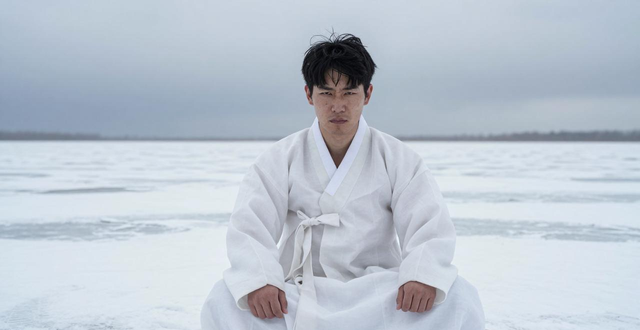
He squeezed his neck inward as much as possible, placed his hands in his sleeves, narrowed his eyes and kept his body still. The white clothes on his body looked extremely thin and fragile in the wind, as if they would break apart with the slightest touch. However, he just sat quietly, relying on the frozen soil behind him, and never spoke. Suddenly, I felt that the white clothes were not just about aesthetics, but represented the dignity of life. Showing the cleanest and simplest side is for the sky and the earth to see. Even if the days in life are full of bitterness and the body feels cold, the skin is white and flawless.
Long Drum Dance and Elephant Hat Dance: Are they danced for people to see, or for gods?
This question is a bit pretentious and unnecessary. However, in Yanbian, watch them dance unique farm music and dance, especially in the form of elephant hats. The dozens of meters long colorful ribbons are danced and rotated in the air to form circles. People below applauded and cheered, and the scene was lively.
But I still can't forget another scene. At a festival held in a certain village, it was not the kind of performance aimed at tourists. There was an old man, perhaps an old entertainer from the past, who drank some rice wine, a little too much, and then left the stage to dance. The speed of his rotation was not that fast, and the ribbons were not dancing so lightly and elegantly. He even almost tripped twice. However, the expression on his face was that he was extremely focused, biting his lips tightly, and staring at the tip of the thrown ribbon with his eyes, as if his entire soul was tied to the ribbon and was being withdrawn from his body in circles.
At that time, the noisy gongs and drums were far away. I feel that it is not a performance, it is a competition and competition between all things in the same world, and it is also a communication and dialogue with himself.
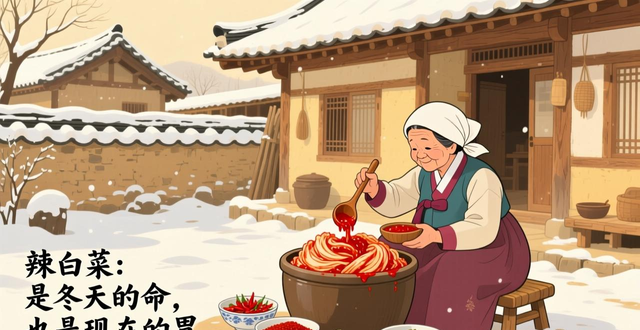
Spicy cabbage: It’s the life of winter and the stomach now
I have seen them prepare spicy cabbage, not just a tiny bit, but hundreds of kilograms. The cabbage, like a snow-white piglet, was carried back from cart to cart. There is a woman wearing an apron, sitting on her knees in the courtyard, applying condiments to the cabbage one by one, such as minced chili, minced garlic, minced ginger, and shredded apples and pears. The ingredients after application are bright red. The woman's hands are covered with many condiments.
That's not a sentiment, it's winter rations. In the past, there were no greenhouses and no out-of-season vegetables. This vat of spicy cabbage was the only bright thing on the tongue of a large family in a winter. Things are different now. You can buy exquisitely packaged kimchi at any time in the city. But I heard a girl from Yanbian say that the most uncomfortable moment for her while wandering in a big city was not that she missed home, but that she took out the kimchi she bought in the supermarket from the refrigerator and took a bite.
The so-called "mita flavor" she mentioned made me think about it for a long time. It is roughly like the pungent taste that comes out of a garlic vat, like the old soup that has accumulated for many years on the edge of the garlic vat. It is like the warmth contained in the palm of the hand, which is the original, fluffy look of life.
The fire bed is still there, and the gayageum is not lost either.
Now heading to Yanji, there are quite a few high-rise buildings. When we arrive at the Korean Folk Garden, young people are wearing improved shorts and long skirts, taking photos and checking in. They look good, as if they have stepped out of a painting.
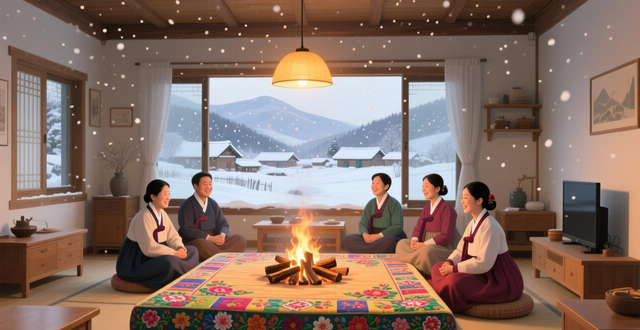
What is particularly interesting is that no matter how modern the house is, when you enter the house, in most cases there is still a kang inside. The warm breath penetrated from the ground upwards, baking people's legs and feet. The temperature outside is minus 20 degrees Celsius. As long as I sit on the kang in the house, my heart will feel peaceful. This may be a "gene" that is difficult to change. Just like the sound of the gayageum and the dongxiao, when listening to it on TV or on the Internet, it always feels like there is a layer between them. It must be one night, when a whimpering sound comes out from the crack of a certain tavern door, mixed with the aroma of rice wine, and then you feel, oh, this thing still exists and has not disappeared.
"Arirang" is not just a song. They never always sing cheerful tunes, but long and long sad notes that seem to pull out a person's internal organs. Although I don't understand the lyrics, I understand the breath that is suffocated in my throat. It is a nation that has traveled over mountains and ridges, walked and stopped, and finally took root in this black soil. All the inner thoughts that are hesitant to express and unable to finish.
What they write is their own story, and it is the story of all of us
In fact, let's talk about it, white clothes, singing and dancing, spicy cabbage, fire bed...
When they are combined, they live a life like that in the past. Now we continue to live according to the past, mixing the rules, smells, and sounds of the past into the present day. Even if the mixture is wrinkled, just like the white clothes of the old man squatting under the wall, it is still his body and his life.
In the wind of Yanbian, these old objects are alive and well. The warm, furry vitality has not dissipated yet.
Comments NOTHING