
Sometimes I feel that things like culture are like the oil stains that have accumulated on the stovetop in my hometown for many years. They cannot be wiped off, but they create the aroma of every meal.
The teacher stated that I needed to write a "cultural composition", but what jumped out in my mind was not poetry or songs, but the "squeak" sound made by the hemp rope penetrating through the thick cloth when my grandmother was doing the act of picking up the soles of her shoes. Can this situation be regarded as culture?
According to what is said in the book, culture is extremely huge, huge enough to accommodate all of history. However, I feel that it is extremely small, so small that it can only be hidden in a word.
What is the "core" of culture?
I have conducted research and found that culture belongs to "the sum of human material and spiritual beings". However, this definition is cold and impersonal.
You have to be able to taste the real culture, right?
Just like last winter solstice, I insisted on eating frozen dumplings, but my mother spent the entire afternoon kneading the noodles and chopping the fillings. She said at that time: "What do you understand? The flour on your hands is passed down from our ancestors." I curled my lips in disdain at the time, but now that I think about it, the flour was kneaded into the flour that her grandmother taught her when she was a child. This is inheritance. Generation after generation of people have the same flour on their hands.
To write about culture, do you have to dig into old papers?
Once many students start writing about culture, they will mention content such as Li Bai, Du Fu, and the Forbidden City and the Great Wall. Although the presentation is good, it always makes people feel as if there is something behind them.
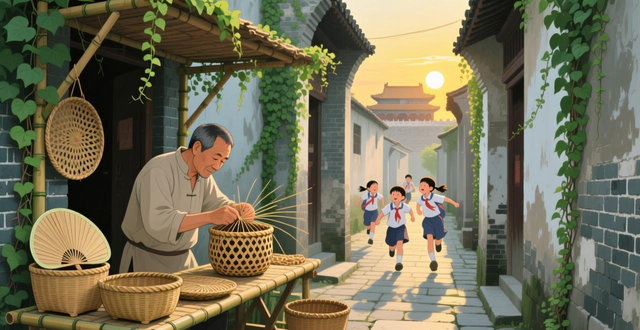
The older male elder in my neighborhood is just an ordinary retired worker, but he possesses a unique and exquisite skill, which is to use discarded wire to twist grasshoppers. The wire was in his hand, and after three twists and two turns, a lifelike grasshopper was born, with its wings trembling.
Can this be counted as culture? I think it is! This is the folk craft that is closest to the reality of life. It is a life form grown from industrial scrap iron. It has not entered the museum, but it actually exists in the hutong where we live.
The "truth" of culture is often incomplete
I suddenly remembered that erhu.
The python skin left behind by my grandfather was already in a state of dilapidation, and the piano rod was also damaged by insect infestation. My dad said he wanted to fix it, but he never got around to it. It has been hanging on the wall like this, showing a tattered appearance.
Every time I see it, I feel like it is making a sound. It is not playing the current songs, but playing the Qin Opera that my grandfather randomly pulled out of tunes at dusk decades ago when he came back from work and drank two ounces of wine with pickles. The sound was like a broken gong, but it smelled of sweat and earth.
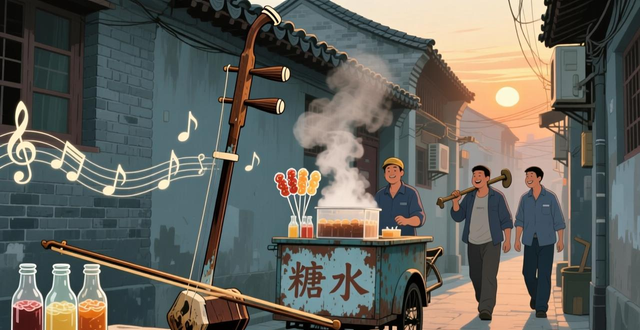
What is culture, and is that what it should be? It is not always a dazzling Tang poetry and Song lyrics. It may be an out-of-tune scream from the broken erhu. This scream shows the fatigue and joy of an era.
And those that disappeared
I heard a few days ago that the ancient millstone at the entrance of the village was taken away, allegedly to build a "folk custom village" and use it as a landscape.
But that millstone, we had stroked it when we were children. It was slippery and felt cold when we put it on it in the summer. It had ground soybeans and grain husks, and it had worn away the youth of my great-grandmother's generation.
Today it is enshrined as a cultural relic, and flowers are planted around it. The appearance is indeed quite beautiful, but it has lost its soul. Once culture exists in the form of "consecration", it is already dying. It should remain alive, should be rubbed repeatedly in people's hands, should be stained with traces of spit, and should continue to be passed down in the daily life that is full of abuse.
As I write this, I kind of understand.
This is not the kind of cultural composition that just piles up allusions and throws off the book bag. To have the ability to hear "The Peony Pavilion" played repeatedly in the headphones of the programmer who worked overtime to the point of collapse in the office building late at night. You also need to have the ability to see the crooked and irregular word "dragon" embroidered on the wide T-shirt of a street hip-hop style boy.
It is a "taste"
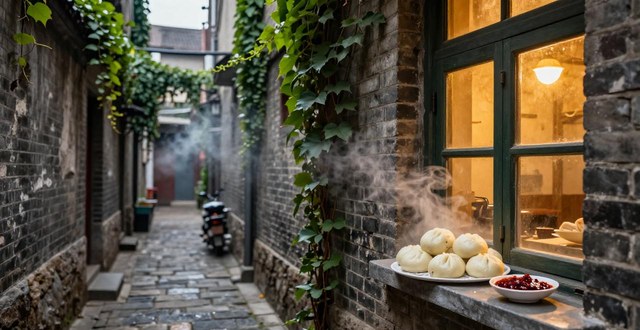
It's a smell that's hard to explain, but once you smell it, you know it's "home".
Just as my grandma said, no matter how a person changes, the things contained in his bones are difficult to change, and the same is true for a nation.
Don't regard culture as so important or so far away, so. It is lying on your window sill basking in the sun, it is hidden in your dialect without any curse words, and it exists in the breath you exhale subconsciously when you pick up the bowl of hot soup.
It has a profound foundation and a vivid outlook, but in the end it will fall back to the delicate and weak place in the human heart.
The distance has reached 1,000 words. I don’t know who is outside the window, and an old song is playing. The lyrics cannot be heard clearly. However, the tune is like the shoe that was lost when running on the field when I was a child. Suddenly it was put back on my feet. Although it was a bit painful, it was really reassuring.
Comments NOTHING