
To be honest, when I picked up the pen, I looked at the calendar - February 24, 2026.
The days go by so fast. The Internet is like a flood. It has overflowed the dams of traditional media very early. Instead of overflowing, it has washed away, and then dug a river channel again on top of the ruins.
To this day, my dad still subscribes to newspapers. Every morning, he put on his reading glasses and flipped through the pages. I told him that there was a lot of news on my mobile phone, but he stared at me: "Can you believe the complicated and disorganized news on your mobile phone?".
He didn't know that the word "faith" itself was now a luxury product.
From "loudspeaker" to "square", no one will listen to you shouting alone
In the past, when watching TV, the whole family must sit upright when the news broadcast was broadcast on time at seven o'clock. This situation belongs to "vertical communication", that is, the broadcast is broadcast at the top, while the bottom can only listen, and there is no room for negotiation.
What now?
Nowadays, who else would always watch TV at that point? In the subway, on the toilet, and on the dining table, there are people holding their mobile phones vertically everywhere. The spread of information has become a "horizontal" situation. It does not flow from top to bottom, but spreads between people, just like a virus. You forward the content to me, and I forward it to him, and he will then send it to Moments.
Is the information relevant? This word has too much academic characteristics and attributes. To be precise, every individual has the opportunity to access information, and even has the right to produce information on his own so that he can use it to "defeat" other people.
Many of those people who were once silent are no longer silent. Even occasionally, their quarrels make my brain feel painful.
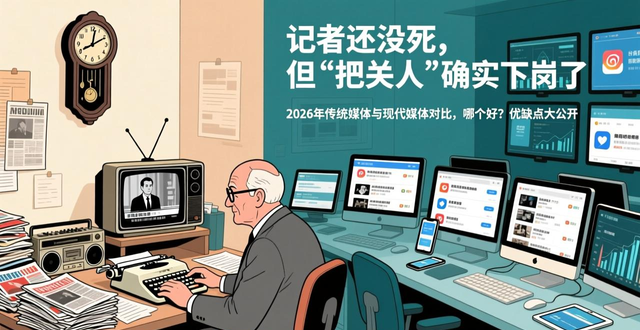
The reporter is not dead, but the "gatekeeper" is indeed laid off
In the past, every word of the content printed by newspapers was written by reporters, modified by editors, and signed by the editor-in-chief. This was the so-called "checking", and this door was extremely tightly closed.
The old article titled "The Last Dignity of Life" written in 2012 is still being found today, with a reading count of 63,000. However, the newly released in-depth report "Live broadcasts for college students, don't follow the "broadcast"" has only read more than 7,000 times.
Ironic, right?
There are new things, but no one pays attention to them. On the contrary, old things have suddenly become classics. Why is it because in that old article, there are reporters who actually go to the scene and conduct face-to-face interviews with the kind of warmth. However, at this stage, there are many reports, and the pictures are all screenshots of mobile phones given by the interviewees.
The lack of the scene makes the word "depth" become shallower and shallower.
In addition, the so-called "National Photography" and the so-called "Young Creator Program" have been added. The audience changes from "spectators" to "experiencers", which sounds pretty good, doesn't it? However, this also means that anyone can publish "news".
Editors are not dead, but the era of "editing is truth" is indeed dead.
Where's the money? This is a fatal question
How do newspapers survive? It's advertising and distribution. In the past, there was the "80/20 rule", which meant that 20% of core users generated 80% of profits.
When the Internet came, everything was in chaos.
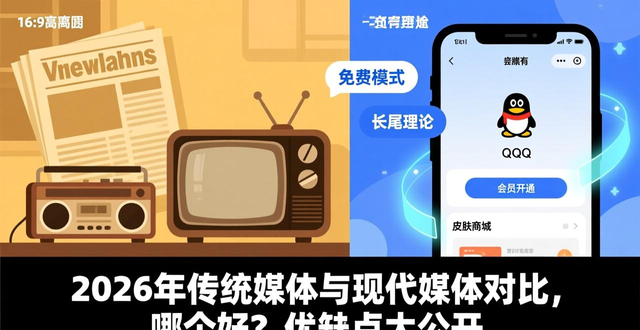
If you take a look at what Tencent has done in the past, it is to use free QQ to win over hundreds of millions of people, and then slowly ask for membership fees and let you buy skins. This approach is called the "free model", also known as the "long tail theory" - it does not focus on the 20% of rich people, but instead makes extremely small amounts of money for the 80% of ordinary people, and eventually accumulates a small amount of money into a large amount of wealth.
Traditional media was dumbfounded.
We not only operate the App, but also open Douyin accounts and WeChat public accounts. The People's Daily has 200 million fans on Douyin, but in terms of the efficiency of content production and interaction, its performance is not as good as that of a leading internet celebrity.
What’s even more frightening is that young people now watch the news instead of searching.
A recent report released by the Reuters Research Institute shows that in the next three years, the traffic provided by search engines to news websites is very likely to drop by more than 40%. The reason is that AI can give answers directly in dialog boxes, so that you can get them without even clicking, and then enter the news website to browse.
The era of "zero click" is here. How else do advertisers invest money?
User is king? Still being regarded as a "traffic leek"
Nowadays it is said that “user is king”.
Data from QuestMobile also shows that the year 2025 in China is a critical transition period for the state of the digital economy to change from quantitative to qualitative changes. Everyone is in the process of transforming from the original "competing for traffic" behavior pattern to a form of "deep research to fully utilize the value of users."
Alibaba launched 88VIP, JD.com launched PLUS, and Meituan launched black gold membership. They claim to give you more benefits and rights, but in fact, they are trying to tightly bind you to the business ecosystem they have built. The more you shop and consume, the more money you save, ultimately making it impossible for you to leave the system.
This is called a "relationship chain", not a "traffic pool".

The auditory experience seems high-end and classy, but in reality, it treats you as a leek waiting to be harvested, and makes you think that you are taking advantage of the opportunity.
Does this existence called "user is king" actually respect you, or is it a more hidden control?
In the end, only the "human touch" remains
In that Reuters report, there was another word that struck a chord with me: “personification.”
Seventy-six percent of media executives said that this year, reporters must be made more like "creators", larger photos must be placed on the page, and reporters must be encouraged to go behind the scenes to do podcasts and record videos, so that they can become living individuals rather than just machines that publish articles.
Why?
Given that AI has extremely strong capabilities, it can generate news-related content, push various information, and respond to your questions instantly. However, it has no feasible method and no corresponding motivation to replace your heartbeat at the scene.
When all information is homogenized into "fluid content" and turned into data modules that can be disassembled and reorganized, what is really scarce are those clumsy, heart-warming, and even sincere sentences that have some grammatical errors.
Just like what I am writing now, the logic may not be strict or the jump may be too great.
But this is what I really want to say on February 24, 2026.
Maybe that's enough.
Comments NOTHING