
To be honest, as I am sitting here typing out these words, my mind is filled with images of the scene when I passed that ancient street yesterday.
The sunshine is still the same, dappled on the soil, no different from decades ago. However, the faint scent of sandalwood was gone in the air, and the old sugar painting stall was also gone. Instead, it was replaced by promotional advertisements played on a loop in the milk tea shop. Suddenly I felt empty in my heart, as if I had lost something vital, but I couldn't tell exactly what I had lost.
We often claim that Chinese culture has a history of 5,000 years and is the only civilization that has never experienced any faults. This is really impressive. Anyone can say such words. The descriptions of the extremely grand scale of the Terracotta Warriors and Horses built during the Qin Shi Huang period and the Great Wall that stretches thousands of miles can really scare people. They are placed in a museum, covered with a glass cover, and coupled with lamps that emit cold light, and then they become so-called "brilliance." But what happens after this?
Those ancestral tablets that have been stepped on
There is a piece of news whose authenticity is difficult to determine. The content is about Ming and Qing stone steles with inscriptions in Guangdong, such as the "Forbidden Monument" and "Stone Lintel Pole". Some of them were taken by villagers and placed on ditches as stepping stones, and some were built into pig pens. Can you imagine such a situation? You must know that these are stones engraved with words and carrying the thoughts of the ancestors. They are soaked in muddy water and suffering from the wear and tear of their soles.
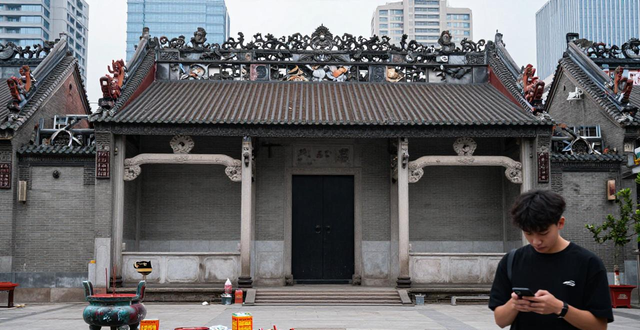
Maybe there's nothing to surprises about. Isn’t our current attitude towards many old things just like a “stepping stone”? When used, take it and step on it; once it is no longer needed, throw it aside. The urbanization level has reached 67%. With a finger swiping across the mobile phone screen, who cares who is being enshrined in the ancestral hall?
Look at that Hanfu, it looks like a prop
It’s not that people don’t want to pass it on, Hanfu is a craze, and the streets are full of young men and women dressed very beautifully. However, how many people know that behind that costume, there are “etiquette” and “respect”, and how to “correct clothes and hats” first and then “know honor and disgrace”?
Many of them just stay in the category of "looking good in taking pictures", which is similar to the situation of renting clothes to take pictures in scenic spots. Once you put it on, you feel like an ancient person, but after taking it off, you still curse when you need to, jump in line when you need to, and culture has become a shell, but the essence inside has long since disappeared. It's not that we want to be harsh, but this matter is quite sad when we think about it carefully. The wisdom of our ancestors has encountered "symbol consumption", leaving only an empty shell.
Why can't we keep that "slowness"?
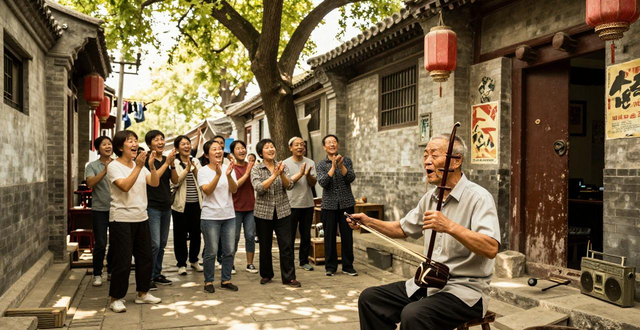
When I was a kid, the old man who performed in the alley would have a scene like that when his voice lit up, and the people around him would cheer. But that is no longer the case. It’s not that Peking Opera is not good to listen to, but that there is no “field” that can create such an atmosphere.
Everyone is busy, busy making money, busy watching short videos. Who has time to sit down and listen to you singing all night long? The pace is so fast that all the things that need to be savored carefully are left behind. The winding paths in the forest have been replaced by asphalt paved roads, and the blue brick houses have been replaced by glass curtain walls. We have lived in more comfortable houses, but we have lost the "flavor of life".
Perhaps, culture is not something that is offered in temples.
It is hidden in the sugar paintings made by old artists, hidden in the broken piece of wood on the lintel of the ancestral hall, and hidden in the ditty casually hummed by grandma. It is not that sacred, it even looks a little dirty and has a shabby feel.
If these things really cease to exist, then we will become a floating duckweed without a foundation, drifting with the waves in a cement forest.
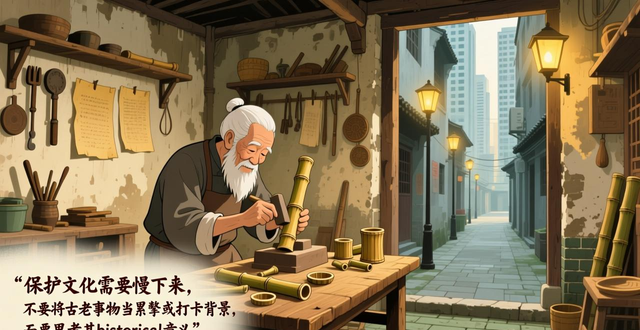
Sometimes I wonder, in order to protect culture, do we first have to learn to "slow down"? Those ancient things cannot be regarded as a burden, nor can they be regarded as the background board for Internet celebrities to check in. Don't always think about how much the "national tide" can be sold for, but think more about why people hundreds of years ago would carve those words on a stone.
I can’t write anymore. The honking horn of the takeaway boy calling for orders sounded outside the window again.
Maybe tomorrow, that old street will be completely demolished.
Comments NOTHING