
Sometimes I wonder what the hell is going on.
That thing that has been passed down from our ancestors for five thousand years has gone through countless storms and waves, and has not cut off its roots even when dynasties changed and wars raged. However, now, when technology is the most advanced and life is the most comfortable, it is almost unsustainable. This is really happening around me, and it is really chilling to think about it carefully.
Who says young people don’t love it? What you see are just slices
I was almost led astray.
Two days ago, I read a report in Sichuan Daily. In the ancient city of Qingxiang in Chengdu, there was a group of "post-90s" and "post-00s" who were parading in Hanfu. There was a "post-85s generation" named Qin Fan who lamented that more than ten years ago, if you wore Hanfu on the street, others would think it was a fancy dress, but now, the horse-faced skirt has become a hot item, and the buyers are basically those born after 2000.
Furthermore, there was a girl from Zigong who was born in 2003. Her statement was quite straightforward. When asked if she dared to wear Hanfu to compare her beauty with international brands, she responded, "Yes. Hanfu has a strong cultural heritage and we should be proud of it."
Li Yucheng, 69 years old, looked at these children and took the initiative to ask for a photo. He muttered: "This is our own culture.".
Yes, this does belong to our cultural category. However, I can't help but wonder, why do I feel that such a scene seems to be more inclined to struggle to survive in the cracks?
The "festival" you celebrated is no longer a festival
Dragon Boat Festival. You know what pops into my head? Zongzi. No more.
While searching, I came across an article on Qiyi.com with a touching title: "Let the Dragon Boat Festival move from taste buds to the heart." The article mentioned that the current Dragon Boat Festival is facing a "cultural paradox", that is, the festival's carrying forms are becoming increasingly abundant, but the cultural inheritance is becoming increasingly weak.
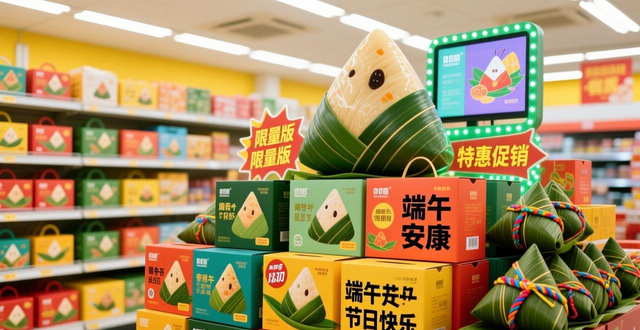
In supermarkets, rice dumpling gift boxes are piled up like mountains, and merchants are using their best efforts to market them. The dragon boat race set a new Guinness World Record. The longest dragon boat and the oldest dragon boat came one after another. The screen was filled with footage of the boat capsizing during the rampage. So, what happens next?
The act of hanging wormwood? The act of wearing a sachet? How to tie colorful rope? The act of drinking realgar wine? No more, they have all evolved into "experience projects" in cultural and tourist attractions, the kind that require money to touch.
Tradition eaten by “algorithms”
There is another thing that is very hidden.
There is an article in Tencent News that explains quite thoroughly, that is, we must be wary of the hidden losses caused by the two-wheel drive situation of "algorithm-consumption". Nowadays, intangible cultural heritage is on the short video platform. In order to meet the requirements of the algorithm, the two-hour opera that originally needed to be performed is compressed into a "highlight clip" of only one minute, and a stimulation point is set every 8 seconds.
The charm of the singing needs to be slowed down to appreciate, the ingenuity of the stitches also needs to be slowed down to feel, and the sense of ritual also needs to be slowed down to appreciate, but now they have all been filtered out.
In the end, what everyone remembers is the curiosity, excitement and visual spectacle.
Culture has become a shell, and the contents inside are empty.
Don’t just blame young people for things like foreign festivals
Indeed, Christmas and Halloween are particularly popular. Shopping malls with Christmas trees are everywhere, and young people dressed up as ghosts are happily having fun.
However, there is an article in the China Youth Daily with a rather tricky angle. It points out that instead of just talking about the impact of "Korean Wave" on us, the term "Korean Wave" was actually coined by the Chinese media at the end of the 20th century. And the aesthetic preferences of Chinese fans have even in turn affected the choices of the Korean entertainment industry.
What does this mean? Young people are not passive acceptors, they are also choosing.
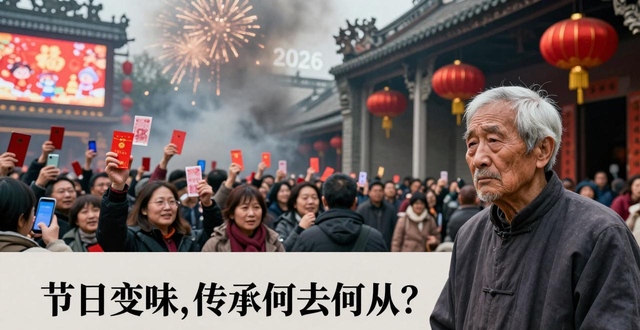
The point is that if the things that belong to us don't occupy this range of choices, then others will naturally enter it.
Don’t misread “national tide”
There is a popular word this year - Generation Z does not follow the top trend but pursues the "old trend".
Students who entered the university went to Baiyuan in Luoyang to sweep Bai Juyi's grave, gave Cao Cao ibuprofen because Cao Cao had a headache, and gave Zhuge Liang a high-speed train ticket from Chengdu to Luoyang. It's funny to watch this scene, but it's actually quite touching.
They regard the ancients not as cold symbols, but as living idols.
Meng Man, a member of the National Committee of the Chinese People's Political Consultative Conference, commented on this matter and said it was a good point. She explained that in the words of "Generation Z", they are "eating chaff."
The ancient style that young people are pursuing now is actually the top style of ancient times.
Where is the real danger?
Having said so many good things, don’t get carried away.
In fact, what is extremely dangerous is that there are a large number of young people who have no idea how the twelve zodiac animals are arranged in order, and they cannot distinguish the difference between Hanfu and Kimono.
What is really dangerous is that medical cosmetology is showing a trend of younger people, there is a phenomenon of fund-raising in the rice circle, and the aesthetic concept of "white, young and thin" is eroding the cognition of minors.
What is really dangerous is that some short videos from foreign countries under the banner of "interesting", mixed with curious and vulgar content, are spreading wildly on campus.
That door won't close when you push it open
There is a saying by Qin Fan that I particularly like.
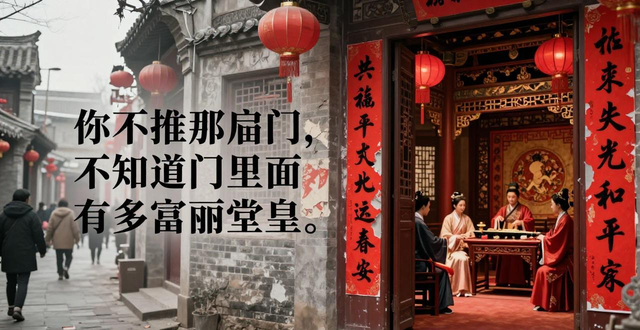
He said: "If you don't push the door open, you won't know how magnificent it is inside."
In the past, he would never mention words like "ancestors". In the past few years, he started to talk about it often and said: "Now I realize that traditional culture is indeed great. Only then can I have the courage to talk about ancestors. This is our most solid support."
In the ancient city of Chengxiang at night, the lanterns reflected on the skirts of the young people and on their armors, looking like flowing clouds.
They opened a door. This door is not just a door to traditional culture, but a door that allows more people to see where they come from.
Don't just worry, do something
Having said so much, it’s actually just one sentence——
Don't just worry, don't just complain.
Walk through that door.
Even if it is making a rice dumpling with your own hands during the Dragon Boat Festival; even if you are telling the story of Qu Yuan to your children; even if you are wearing Hanfu and walking around in a circle; even if you are trying to cut a window grille.
Something that has lasted five thousand years has been passed down to you.
Don't let it break in your hands.
Comments NOTHING