
Why do I desperately want to give my children my childhood, but I get slapped in the face by "scientific parenting"?
The day before yesterday, I went downstairs to throw away the garbage. I saw Grandma Li, who lives on the third floor, squatting on the ground and drawing a grid with her two-year-old granddaughter.
The chalk is broken and the grid is crooked.
But the moment the little girl jumped in, Grandma Li's eyes lit up.
That kind of brightness was not the feeling of relief expressed when "Look at how wonderful the child is", but - she herself was involved in it.
We always say that there is a "generation gap" between the elderly and their children, but where is the gap?
In fact, it’s not about the concept.
Parents of our generation really know too much about so-called "education", such as sensory integration training, bilingual enlightenment and logical thinking. We divide our children's time into development indicators, and then complain that the elderly cannot help us.
But what can the old man do?
They can play hopscotch, they can play the game of twist and turn, and they can hide the words "kiss grandma" between the east, west, and northwest.
There are no key performance indicators for these things, but there is one thing that we have lost, and that is a sense of equality in companionship.
Hopscotch is not training but "occupying territory"
What's too complicated is the original gameplay. You have to jump on one foot, and you can't press the line when throwing stones. A two-year-old child can't even say his own name, but you ask him to abide by the rules?
I changed it.
Level 1 : Put a small doll in the grid. Skip to 1 and get it. It's that simple.
Second level : Place another one in grid 2. And so on.
When my younger brother was playing, he ignored the grids and ran straight in to pick up things. At that time, my grandma was so anxious that she stamped her feet and shouted: "Jump! Jump!" Then she demonstrated it herself, but with a pop, she fell to her buttocks.
The two of them were rolling on the ground laughing.
After that, grandma created a new rule, that is, whoever picks up more dolls can place the dolls in the "home" (a certain grid) as guards. In order to be able to place more, the younger brother began to seriously learn to jump on one foot.
Muscle exercise has stimulated the waist, the cognition of numbers has been learned, and the understanding of "mine" and "yours" in the division of space has been clearly understood.
But that's not what impressed me the most.
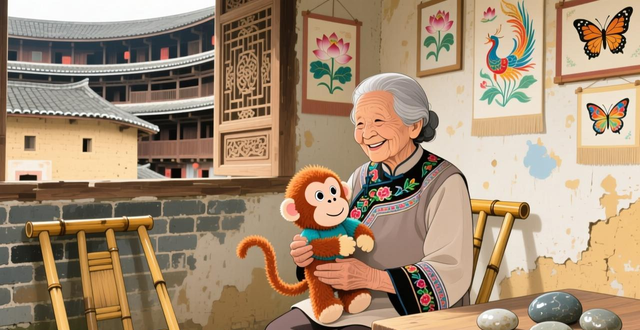
The moment my grandma picked up that doll, she said something like this: "This little monkey is so much prettier than the stones I played with when I was a child."
Southeast, northwest, not just a prank
I played this when I was a kid, and the words in it were all about "learning how to bark like a dog" and "beating the palms of your hands".
When it was my kids' turn to play, I painted the eight sides in different colors.
"Turn over red and look for red things at home."
The two-year-old brother, holding high the objects in the southeast, northwest and northwest, ran back and forth in the house, shouting constantly: "Red! Red!", and finally stopped in front of his grandfather's red socks, looking very proud.
My three-year-old brother is playing more complicatedly. I write shapes in it, including rectangles, circles, and triangles. Whatever I turn over, I match it to the objects at home.
Televisions are rectangular and clocks are round.
The most difficult thing about this game is that children need to switch back and forth between the two-dimensional one, which is the color or shape presented on the paper, and the three-dimensional one, which is the real object in reality. This is much more difficult than simple matching.
But the old man had a great time.
Since there is no need for them to teach, they only need to act as "partners" and search together with the children. If they lose, they will be punished, and if they win, they can look proud.
Before the rules, everyone is equal.
The maze on the ground was taught to me by my children
One day my brother lined up the blocks in a long line and said "road".
I took a piece of chalk, drew a simple maze on the ground, placed a few doll monkeys, and then said: "The monkeys have lost their way, how about saving them?".
The younger brother walked along the line, taking every step carefully.
My brother ran over quickly and added a few signs called "parking lot" at specific locations. At the same time, he said: "There will be vehicles driving out here, so be careful!".
Children are creating rules rather than obeying them.
What does the old man do at this time?
Standing there watching, sometimes asking: "Is this road accessible?" "Hey, what should I do if there is a vehicle ahead?".
Asking questions is much more difficult than giving guidance. The reason for this is that asking questions shows that you are actually in a state of curiosity and that you are actually following the child's thinking.
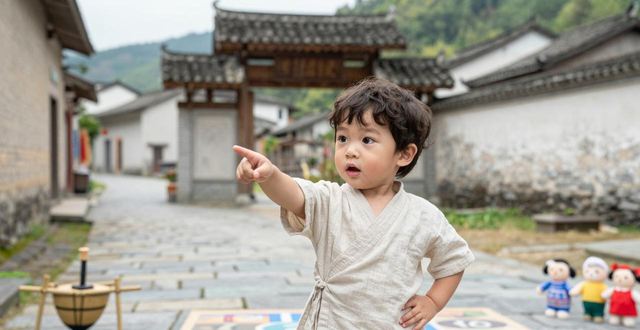
When the younger brother, who was just learning to speak, reached the fork in the road, he turned his body to the right, pointed with his finger, and finally choked out one word: "right."
I squatted down slowly, looked straight into his eyes, and said with hesitation, "Go to the right, brother, are you guiding us to go to the right, right?"
Later he talked more. Because the game requires expression.
As I write this, I suddenly feel like crying.
When I was a kid, my grandma also jumped around the house with me.
At that time, the term sensory integration disorder did not exist. Grandma did not know that she was helping me develop my balance ability. She only knew that when I jumped in, I laughed extremely loudly.
Now that I have a child, I read various parenting strategies every day for fear of missing any sensitive period.
But is the significance of those long-standing games really just for exercising, learning mathematics, and practicing language?
No.
They allow three generations to become children at the same time in the same space.
Grandpa lost the game of southeast, northwest, so he had to meow like a cat. The younger brother laughed and clapped his hands non-stop. At that moment, grandpa was not the elder, but the "teammate" who was being punished.
Grandma accidentally fell down and injured her butt while doing hopscotch, but she still stood up and continued jumping. What the child witnessed was, oh, it turns out that adults also fall, it turns out that they can smile after falling, and it turns out that they can continue to laugh after laughing.
Which parenting book can teach this?
Of course we need to change it, but not for "teaching"
If the two-year-old cannot jump around the house, we change it to "walking" the house and "picking up toys".
In the directions of east, south, west and north, instead of writing "barking like a dog", write the color, shape and shape, and "go hug grandpa".
If the old game wants to survive, it must change.
But this change is not to make it more like a "teaching aid", but to allow a two-year-old child to hold his hands, to allow an 80-year-old man to jump his legs, and to enable children and the elderly to play together in a situation of the same difficulty level.
If you search for "traditional game improvement" on the Internet, many professional solutions will appear. These solutions include benchmarking core experience, decomposing action goals, setting gradient tasks, etc.
All correct.
But the one that touched me the most was the game my brother designed himself.
He built a maze with building blocks and placed a candy at the end of the maze. Then he took grandma's hand and said: "Grandma, go this way. This side is safe, but there are monsters over there. I will protect you."
Grandma pretended to be scared: "Where? Where is the monster?"
The elder brother puffed up his chest and said, "Don't be afraid, I've beaten it."
At that moment, there were no old people or children in the game, just two partners fighting side by side.
The last thing I want to say
Our generation wants the “best” for our children too much.
The best early education, the best toys, and the best way to accompany you.
At some point, the best things are in the hands of the old. The old games are about to be lost, like hopscotch, like jigsaw puzzle, like southeast, northwest, etc. They were clumsy, they were simple, they had no sound, light or electricity. But they are the only light for the old man when he is young.
When grandma squats on the ground and draws a grid, what she draws is not a game.
It was the "home" she fought over with Erya next door when she was seven years old.
When grandpa folds the east, west, east, and west, he doesn't fold paper.
It was the pounding of his heart when he secretly wrote "who he likes" in it when he was ten years old.
It is not for the purpose of making the elderly happy that the children play old games with the elderly, nor is it for the purpose of making the children happy.
It is to let our childhood live in the childhood of our children.
It makes those stories that touched our hearts in the past, such as the competitive heart during hopscotch, the secrets hidden in the southeast and northwest, and the panic of taking the wrong path in the maze and then twisting and turning, once again have fresh vitality in another child.
Yesterday evening, my brother took grandma downstairs again.
He was holding the box of small dolls, and grandma was holding half of the chalk.
I asked: "Why go?"
The younger brother said: "Build a house. Live with grandma."
Grandma smiled so hard that her eyes narrowed: "Yes, build a big house for us to live in."
I think that's enough.
Comments NOTHING