
Traditional culture was nurtured by the five thousand years of Chinese civilization. Now it is at a new crossroads, that is, will it become a display in a museum, or can it truly be integrated into modern people's lives? At present, folk cultural exchanges have unprecedented vitality, which makes ancient wisdom "alive" again on the streets and on fingertip screens.
People-to-people exchanges allow culture to take root in life
On the night of the Lantern Festival in 2026, a traditional lantern show attracted more than 30,000 tourists in Sanfangqixiang, Fuzhou. This lantern show was spontaneously organized by community residents. Unlike the grand official events, the lanterns here are handmade by local elderly people and their children using bamboo strips and rice paper. 76-year-old Grandma Lin told reporters that she learned this craft from her father when she was a child. Now when she greeted people in the community group, more than 20 families responded.
This kind of cultural inheritance developed from bottom to top just makes up for the shortcomings of official promotion. In Yiwu, Zhejiang, businessmen from the Middle East were learning to make rice dumplings when they heard people nearby telling the story of Qu Yuan; in Lijiang, Yunnan, the Dongba characters of the Naxi ethnic group were made into emoticons by the younger generation and spread in WeChat groups. Culture is not the established meaning in textbooks, but the warm interactions in daily life.
Social media becomes a new communication front
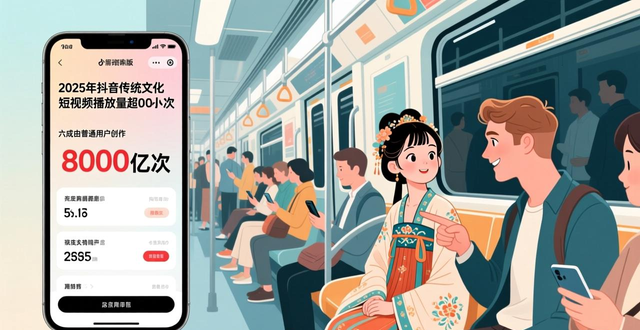
Throughout 2025, the number of short videos related to "traditional culture" on Douyin reached and exceeded 800 billion times. This is what Douyin data reveals, and more than half of them were created by ordinary users, accounting for more than 60%. In Xi'an, there is an enthusiast named Xiao Chen who is passionate about wearing Hanfu. She wears various styles of Hanfu and takes the subway to commute to get off work every day. She has an account with as many as two million fans. In the comment area of her account, you can often see foreign friends asking about the specific shape of Hanfu.
What deserves more attention is that after Henan TV's "Chinese Festival" series became popular, a large number of netizens carried out secondary creative actions based on their own wishes. On the one hand, they paired classical dance with modern music, and on the other hand, they filmed intangible cultural heritage skills into short video tutorials. Such a model, in which "officials set up a stage and folk performed", has enabled traditional culture to successfully break through the dual limitations of time and space. In other words, Miao embroidery in a mountain village in Guizhou can be seen by designers in Paris through live broadcast.
Cross-border people-to-people exchanges are becoming increasingly frequent
In the summer of 2025, there was a cultural exchange group composed of chefs from China and France. They held an event called "Taste Dialogue" in Lyon, in which the Chinese chef demonstrated the twenty-four flavors of Sichuan cuisine, while the French chef used Burgundy red wine to cook the Chinese pork belly. In addition, the initiator of this event was not a government agency, but a group of overseas Chinese who opened Chinese restaurants in France.
Similar stories are also going on in Africa. In Nairobi, Kenya, Chinese aid workers joined hands with local people to celebrate the Dragon Boat Festival, making dragon boat races a popular local activity. In Hamburg, Germany, a group of Chinese students organized a folk music pop-up that made passersby in front of the Bach Concert Hall stop and listen. These activities initiated and organized by the private sector are often closer to the actual people's sentiments than official performances and are easier to be accepted by the locals.
Intangible cultural heritage protection spawns new business formats
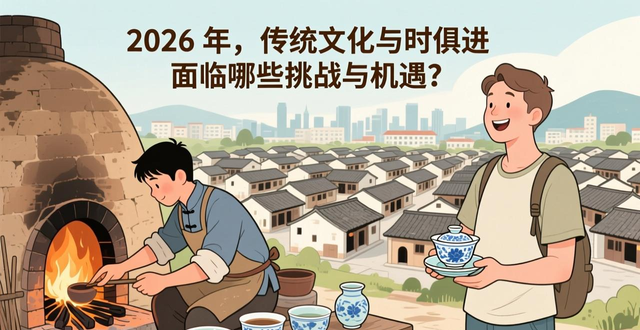
The latest data released by the Ministry of Culture and Tourism shows that there are currently more than 100,000 representative items of intangible cultural heritage recognized in our country, and almost 40% of them achieve self-hematopoietic function through a protective method of productive behavior. In the case of Jingdezhen, the ancient porcelain-making technology has enabled the creation of more than 2,000 individual work and business places, creating a value of more than 5 billion yuan every year. Xiao Wang, a person born in the 1990s who is engaged in related skills, told reporters that 60% of the tea sets he fired in wood kilns were sold to foreigners visiting Jingdezhen.
Inheritors of intangible cultural heritage have transformed from mere "protected objects" to active forces in cultural dissemination. Master Wu, the inheritor of the Miao silver jewelry forging skills, receives more than 20 groups of foreign study groups every year, and hangs the works of students from various countries in his studio. He said: "I used to worry that skills would be lost, but now I find that there are people all over the world who want to learn."
Cultural products go overseas to show a new look
In 2025, at the China International Fair for Trade in Services, a domestic game attracted attention. This game is called "Wandering in the Garden". In the game, the Kunqu opera arias are recorded by professional actors, and the scene design refers to "A Thousand Miles of Rivers and Mountains". Only three months after its launch, the game's overseas downloads exceeded 5 million. Players spontaneously discussed the singing characteristics of Kunqu Opera in the forum, and some people actually started learning Chinese because of this.
At the same time, domestic film and television dramas went overseas, thereby promoting the spread of culture. When "Thirty Thousand Miles from Chang'an" was released in Southeast Asia, audiences there became very interested in Tang poetry, and there was a craze on social media to "follow the movie and learn Tang poetry." These cultural products move towards the world through commercial channels and are more vital than simple promotional activities.
Online and offline collaboration to build a new ecosystem
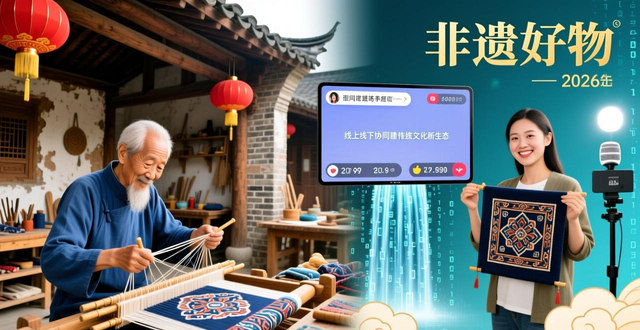
During the Spring Festival this year, Shanghai Yuyuan launched the "Lantern Festival on the Clouds", with a daily limit of 30,000 people offline. However, the number of tourists received in the online virtual space exceeded 2 million. Visitors can place electronic sky lanterns on their mobile phones, and can also hear inheritors of intangible cultural heritage explain the craftsmanship of lantern production. This model not only protects cultural relics and buildings, but also expands the audience.
What deserves more attention is that the countryside is now gradually evolving into a key and important position for the revitalization of traditional culture. With the help of the "Old House Rescue Plan", Songyang County in Zhejiang has successfully attracted a large number of urban youth to return to the countryside to start businesses. These urban youths who have returned to the countryside to start businesses use short videos to record the daily life of traditional villages and sell locally produced agricultural products through live broadcasts. In this way, hollow villages are once again full of vitality. Relevant data clearly show that the number of tourists the county will receive in 2025 will increase five times compared with before the renovation.
After reading this article, have you ever participated in some form of folk cultural exchange? Is there any experience that gave you a new understanding of traditional culture? Welcome to share your story in the comment area and like it so that more people can witness the new vitality of traditional culture.
Comments NOTHING